PBO Fabric-Satin | PBO Fiber Fabric | Flame Retardant Fabric
What is PBO Fiber?
PBO fiber, short for poly(p-phenylene benzobisoxazole), also known as Zylon PBO fiber, is widely regarded as the “super fiber of the 21st century.” It originated in the 1980s in the United States, developed as a reinforcement material for composite applications in aerospace. As one of the most promising members of the heteroaromatic polyamide family, PBO fiber (Zylon) stands out for its exceptional mechanical properties and extremely high thermal resistance.
A single PBO filament with a diameter of just 1 mm can lift 450 kg, giving it a tensile strength more than 10 times that of steel wire. The decomposition temperature of PBO fiber reaches as high as 650 ℃, and its limiting oxygen index (LOI) is 68%, making it one of the strongest and most reliable flame retardant fabric materials among organic fibers.
Production of PBO Satin Fabric
The production of PBO fabric-satin is a complex, high-tech process, consisting of the following steps:
- Fiber preparation: PBO fiber is manufactured through a sophisticated process of chemical synthesis and spinning.
- Yarn processing: PBO filaments are twisted, plied, or otherwise processed into yarns suitable for weaving. To further enhance performance, covering techniques may be applied, such as spirally wrapping PBO staple yarns around stainless steel filament yarns to form composite yarns.
- Weaving: Using high-speed looms, the yarns are woven into satin weave structures. Satin weave is characterized by fewer interlacing points and an even distribution, giving the fabric a smooth surface and high luster.
- Finishing: The woven greige fabric may undergo a series of finishing treatments to improve its performance. For instance, to enhance the UV aging resistance of PBO fibers, special preparation methods can be employed, such as acid-etching modification and carbon-based suspension treatments, which create an anti-UV coating on the fiber surface.
These steps ensure that PBO flame fabric combines strength, thermal resistance, and surface smoothness—making it ideal as a flame resistant fabric for industrial and aerospace use.
Technical Parameters of PBO Fiber Fabric
| Category |
Parameter |
Typical/Estimated Value (Based on PBO Fiber) |
Notes & Sources |
| Mechanical Properties |
Tensile Strength |
Very high (up to 5.8 GPa for PBO fiber) |
Actual fabric strength affected by weave structure |
| Tensile Modulus |
Very high (up to 270 GPa for PBO fiber) |
Indicates resistance to deformation |
| Elongation at Break |
Low (approx. 2.5% for HM-type PBO fiber) |
High-modulus, low-elongation fiber |
| Thermal Properties |
Continuous Service Temp. |
Up to ~350 ℃ or higher |
Potential to replace inorganic fibers above 350 ℃ |
| Decomposition Temp. |
~650 ℃ |
|
| Limiting Oxygen Index (LOI) |
68% |
Classified as a flame retardant fabric material |
| Other Properties |
Density |
~1.56 g/cm³ |
Heavier than water, but much lighter than metals |
| Moisture Regain |
~0.6% |
Very low moisture absorption |
| Chemical Resistance |
Excellent |
Stable against most chemical reagents |
Application Prospects of PBO Flame Resistant Fabric
Aerospace and Defense
Used in secondary aircraft structures, satellite components, and protective materials around rocket engines. Its high specific strength and thermal resistance help reduce weight and improve performance. In ballistic protection, PBO fiber Zylon can be applied to bulletproof vests, helmets, and armored vehicle armor as a high-grade flame resistant fabric material.
High-Performance Industrial Protection and Reinforcement
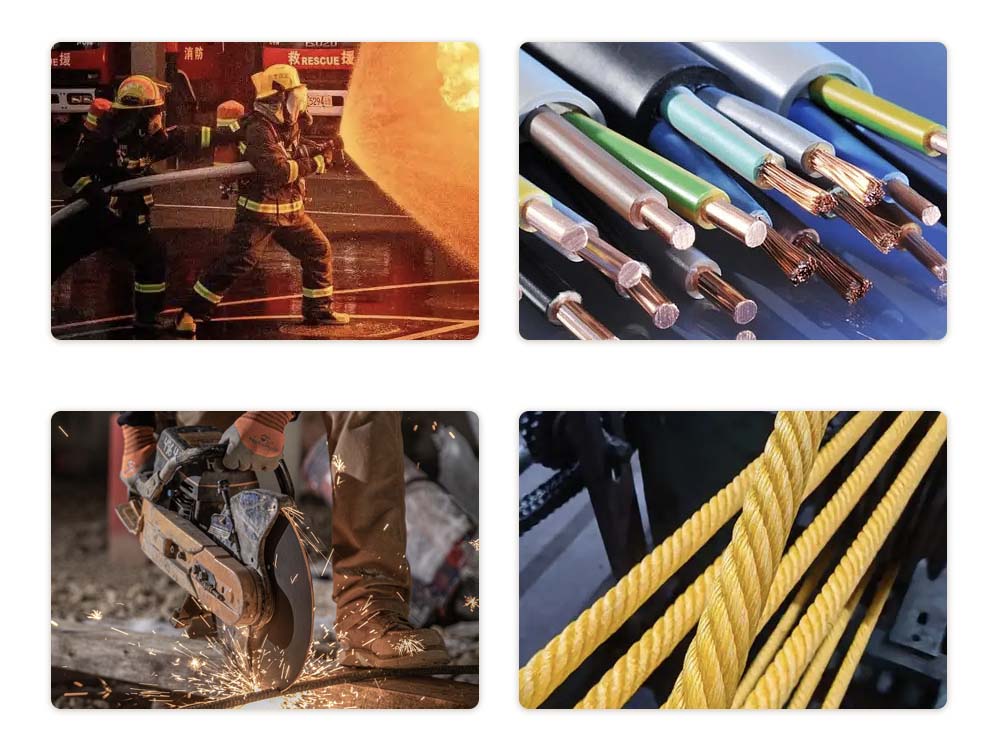
As a fabric flame resistant to heat, it is suitable for protective clothing, insulation blankets, and conveyor belts in high-temperature environments. Below 350 ℃, it may replace aromatic polyamides; above 350 ℃, it has the potential to substitute stainless steel fibers or ceramic fibers. In high-speed rail, PBO fiber composites can reduce structural weight and increase strength. For bridge construction, PBO fiber ropes—lightweight yet strong— are ideal for long-span bridges.
High-End Sports and Outdoor Equipment
Applied in sports gear requiring extreme strength, durability, and light weight, such as professional yacht sails, golf clubs, tennis rackets, skis, and high-performance bicycle frames. The smooth surface of satin weave fabric may also help reduce drag during motion. This demonstrates the versatility of fire flame fabric for both safety and performance applications.
Specialized Safety and Industrial Products
Thanks to its chemical resistance, PBO flame retardant fabric can be used in corrosion-resistant protective clothing. It is also suitable for high-grade cut-resistant gloves, safety ropes, and other specialized equipment, supporting the growing flame resistant fabrics market. For industries needing to buy flame retardant fabric, PBO is considered one of the most advanced and reliable solutions.