Explore fiber-reinforced resin composites in helicopters, including carbon, glass, and aramid fibers, their structural applications, performance benefits, and trends.
Application Status of Fiber-Reinforced Resin-Based Composites, Including Aramid, in Helicopters
Abstract
This paper introduces the relevant characteristics of fiber-reinforced resin-based composites and the types and properties of commonly used fiber-reinforced resin-based composites in helicopters. It describes the structural characteristics of helicopters and the specific application parts and current status of fiber-reinforced resin-based composites in helicopters. The structural characteristics, material selection, and functions of these application parts in helicopters are discussed, and the future development trends of composite materials for helicopters are also anticipated. Research shows that fiber-reinforced resin-based composites have achieved widespread application in helicopters due to their excellent material properties, playing a vital role in the advancement of helicopter technology.
01 Introduction
Composite materials are new material systems formed by combining several materials with different physical and chemical properties, such as organic polymers, inorganic non-metals, or metals, through composite processes, achieving different structural scales and levels (microscopic, mesoscopic, or macroscopic) through complex spatial combinations. Composite materials typically use resins, metals, and ceramics as the matrix and high-performance reinforcing materials such as fibers, fabrics, and whiskers as reinforcements, manufactured through special material composite processes. Material composites can retain the original characteristics of the constituent materials while acquiring new properties, which is of great significance for improving the overall performance of materials. Currently, composite materials have developed into one of the four major material systems alongside metallic materials, inorganic non-metallic materials, and polymer materials. Composite materials possess many characteristics such as high specific strength, high specific modulus, low specific gravity, light weight, designable properties, and stable chemical properties. When applied to helicopter structures, they can effectively improve aircraft performance, ensure flight safety, and achieve structural weight reduction. With the rapid development of composite materials, the application and quantity of advanced composite materials in key parts of aircraft have become one of the important indicators for measuring the advancement of aircraft structures.
02 Fiber-Reinforced Resin-Based Composite Materials
Fiber-reinforced composite materials are composite materials prepared by various molding processes such as winding, molding, or pultrusion of reinforcing fibers and matrix materials. The fibers, as reinforcing materials, are the main component of fiber-reinforced composite materials. The fibers used are very small, generally with a diameter of less than 10 μm, have few defects, and possess high strength and modulus, making them the main load-bearing parts of the composite material. The matrix material is often a tough material with viscoelastic and elastoplastic properties, capable of withstanding large strains and serving to bind and protect the fiber materials, playing a crucial role in maintaining the integrity and consistency of the composite structure. Fiber-reinforced composites have high specific strength, high specific stiffness, good damping performance and fatigue resistance, and their properties can be designed according to requirements, making them the primary material choice for composite components in the helicopter field.
The materials commonly used in helicopters are fiber-reinforced resin-based composites, where the reinforcement is high-performance fiber material and the matrix is high-performance resin material. The type, orientation, and quantity of reinforcing fibers significantly affect the density, strength, and fatigue performance of the composite material. Commonly used fiber reinforcement materials include carbon fiber, glass fiber, and aramid fiber. The role of the resin matrix is to bond the reinforcing materials together, protect the fibers from external physical and chemical factors, and also hinder crack propagation when fibers break. The selection of the resin matrix material determines the toughness, resistance to damp heat aging, and service temperature of the composite material. Resin matrices are generally classified into thermosetting and thermoplastic types. Thermosetting resins mainly refer to epoxy resins, bismaleimide resins, and polyimide resins; thermoplastic resins include ethylene, nylon, polytetrafluoroethylene, and polyetheretherketone (PEEK). Thermosetting resins have a long history of application, while thermoplastic resins were introduced later. However, their development has been rapid in recent years, and their characteristic of being reversible after curing greatly improves the recyclability of composite materials. Currently, thermoplastic fiber-reinforced composite materials are used in many helicopters abroad. This article introduces several types of fiber-reinforced resin-based composite materials commonly used in helicopters at present.
2.1 Carbon Fiber Reinforced Resin-Based Composite Materials
Carbon fiber is a fibrous microcrystalline graphite material with a carbon content of approximately 95%. It is mainly produced by carbonizing and graphitizing organic fibers at high temperatures of 1300℃~1800℃ under inert gas protection. Carbon fiber possesses excellent properties such as high strength, high modulus, low density, no creep, high temperature resistance in non-oxidizing environments, good fatigue resistance, good corrosion resistance, and good electrical and thermal conductivity. It is currently the most widely used and most important reinforcing material. Among them, carbon fiber reinforced resin matrix composites, formed by combining carbon fiber with resin materials, exhibit the best comprehensive performance among existing structural materials and are most widely used in helicopters, with carbon fiber reinforced epoxy resin matrix composites being a typical example. After years of verification, epoxy resin matrices possess numerous advantages such as excellent comprehensive performance, good processability, and low cost. To further improve the performance and quality of composite materials, bismaleimide resins and high-temperature resistant polyimide resins have been successively developed. Carbon fiber reinforced composites made with bismaleimide resins and other materials as matrices are gradually being applied in helicopters, improving their adaptability and durability in harsh environments such as high temperatures and high heat.
2.2 Glass Fiber Reinforced Resin Matrix Composites
Glass fiber is a high-performance inorganic non-metallic material with high strength and elasticity, as well as advantages such as strong heat resistance, good insulation, and corrosion resistance. Composite materials made with glass fiber as a reinforcing material can effectively improve the material's performance and density. Glass fiber epoxy resin matrix composites are mainly used in helicopters. Composite materials made from different types of glass fibers have different properties and applications. Based on practical application requirements, glass fiber reinforced resin matrix composites made of glass fiber cloth, glass tape, and chopped fibers are commonly used in the fabrication of helicopter components.
2.3 Aramid Fiber Reinforced Resin Matrix Composites
Aramid fiber is a new type of high-performance synthetic fiber material, also known as aromatic polyamide fiber. Aramid fiber possesses excellent high-temperature resistance and anti-aging properties. It is lightweight yet high-strength, weighing only about 1/5 the weight of steel wire, but with a strength 5-6 times that of steel wire. Kevlar fiber produced by DuPont is a typical example of aramid fiber. The strength performance and lightweight design provided by aramid fiber reinforced resin matrix composites effectively enhance the helicopter's responsiveness and lethality.
03 Helicopter Structural Characteristics
Helicopters possess unique flight capabilities and distinctive structural forms, making them the only transportation tool currently capable of reaching any terrain. The helicopter structure mainly consists of two parts: the rotor system and the fuselage structure. The helicopter rotor system consists of two main parts: the rotor blades and the rotor hub. The rotor blades can be further divided into main rotor blades and tail rotor blades. The rotor system is a unique moving component structure on a helicopter. Rotation of the rotor provides lift, control force, and forward thrust, enabling the helicopter to perform various aerial operations, including vertical takeoff and landing, hovering, forward flight, lateral flight, U-turn flight, and low-altitude flight. Furthermore, in the event of an engine failure, the rotor system can utilize its existing rotational kinetic energy and the helicopter's own potential energy to autorotate the rotor, ensuring a safe descent and gliding landing.
The fuselage structure is a crucial component that supports and secures the helicopter's parts and systems, connecting them into a unified whole. It is responsible for carrying and transporting personnel, equipment, and supplies. The shape of the fuselage structure significantly impacts the helicopter's flight performance, handling, and stability. Helicopter fuselage structures must prioritize weight reduction, and military helicopters must also consider design features such as bulletproofing, crashworthiness, stealth, and energy absorption. Furthermore, helicopters generally fly at altitudes below 6000m, with some reaching as low as 15m, making them low-to-medium altitude aircraft. Their primary operating environments are harsh conditions such as humid/hot, dry/cold, sandstorms/rain, and seawater. Therefore, helicopter airframes typically require excellent weather resistance and corrosion resistance to meet the stringent requirements of different regions and climates.
04 Application of Fiber-Reinforced Resin-Based Composite Materials in Helicopters
4.1 Rotor Blades
The breakthrough development of composite materials in helicopters began in the 1960s with the successful development of glass fiber reinforced composite rotor blades for helicopters such as the BO-105 from MBB (Messerschmitt-Bolkow-Blohm) in West Germany, the SA341 "Gazelle" from Aerospatiale in France, and the Ka-26 from Kamov in Russia. This marked the beginning of the application of composite rotor blades in helicopters.
Today, helicopter technology has advanced to the third and fourth generations, with rotor blades widely designed and manufactured using composite materials. Compared to the metal blades used in early helicopters, composite blades have a significantly longer service life, generally exceeding 6000 hours, unlike the typical 2000-hour lifespan of metal blades. Composite blades are easier to repair, have lower maintenance costs, shorter maintenance cycles, and allow for single-blade interchangeability. The application of composite blades has greatly improved helicopter operational efficiency and safety, reduced the total lifespan cost of helicopter rotor blades, and brought considerable economic benefits.
Fiber-reinforced resin matrix composites, due to their excellent performance and designability, have been widely used in helicopter composite blades, accounting for approximately 70% of current blade usage. Components made from fiber-reinforced resin matrix composites in composite blades mainly include skins, spars, and joint fillers, all of which are key components of the blade. The fiber-reinforced resin matrix composites used in blade manufacturing, also known as prepreg, are made by pre-impregnating fiber materials into a resin matrix under strict control.
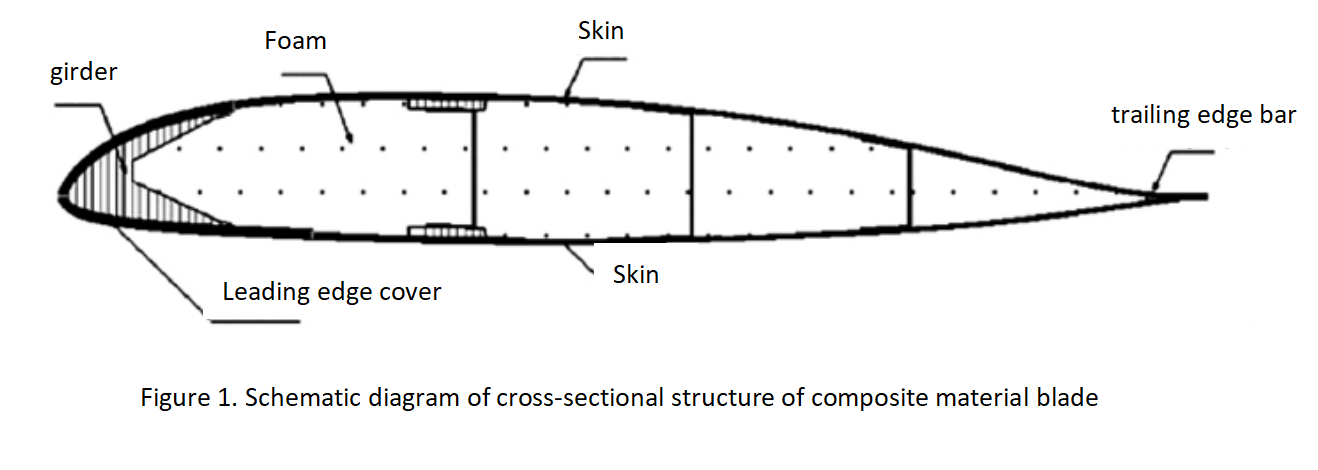
The skin is a crucial load-bearing and shaping component of the blade, providing primary torsional and tetanic stiffness. It is mainly composed of carbon fiber prepreg and glass fiber prepreg, and different skin layup options allow for the design and manufacture of composite blades with varying performance qualities. The spars are the main load-bearing component of the composite blade, located at the leading edge. This area typically serves as the windward side during blade rotation and experiences the greatest wind resistance, thus requiring high structural strength and stiffness. The spars are primarily made of high-strength glass fiber reinforced resin-based composite material, typically laid along the blade span. The joint filler is made of chopped fiber resin-based composite material, generally using chopped glass fibers. Located at the blade root, the joint filler needs to be pre-formed before blade molding and assembly. The blade root connects to the hub, and all dynamic and static loads are transferred to the hub through it, making it the most complex part of the blade structure under stress. Due to the numerous and complex components at the blade root, the performance, shape, and positioning of the joint filler directly affect the blade's molding quality and strength. Furthermore, the trailing edge slats, which play a crucial role in regulating blade wobbling, are generally made of high-strength glass fiber reinforced resin matrix composites. Currently, domestic helicopter composite blades primarily use medium-temperature curing fiber-reinforced resin matrix composites, employing a one-time co-curing compression molding method. Foreign composite blades utilize secondary bonding and high-temperature curing processes during manufacturing. With the rapid development of new materials, processes, and equipment, helicopter composite blades will unlock even greater possibilities in the future.
4.2 Blade Hub
The blade hub is a vital component that mounts the rotor blades and connects the rotor system to the transmission and control systems. Traditional blade hubs are mostly made of metal, assembled from many precision parts, resulting in a very complex configuration and high manufacturing and maintenance costs. How to simplify structural design, reduce manufacturing difficulty, and achieve structural weight reduction while ensuring blade hub performance and quality has always been a focus of research efforts. With the development and application of composite materials, new breakthroughs and possibilities have emerged in designing and manufacturing rotor hubs that are simple in structure, stable in performance, safe and reliable, and highly efficient.
Currently, the main application research of composite materials in rotor hub structures focuses on realizing bearingless rotor hub structures by utilizing the properties of composite materials. Bearingless rotor hubs eliminate the three mechanical hinges of flapping, pitching, and yaw motions, representing a major breakthrough in rotor technology and signifying the development direction of rotor design technology. Bearingless rotor hub structures use flexible beams and sleeves to replace the mechanical hinges in these three directions, with the flexible beam being the key component. In bearingless rotor systems, the degrees of freedom for flapping, pitching, and yaw motions of the blades are all provided by the deformation of the flexible beam. The emergence of the flexible beam can greatly simplify the rotor structure, reduce assembly components, and lower maintenance costs. The construction of the flexible beam is very complex. Considering its stringent load-bearing conditions and performance requirements such as allowable strain of the materials used in its fabrication, high-performance glass fiber reinforced resin matrix composites are primarily selected for manufacturing flexible beams. Flexible beam technology for helicopters is mature overseas, and bearingless rotors have been successfully applied to various helicopters, such as the EC-135 and RAH-66. Domestic research and development of flexible beam structure design and fabrication technologies is also underway, and it is expected that this new rotor technology will be successfully applied to domestic helicopters in the near future.
4.3 Airframe Structure
Helicopter airframes have large curved surfaces, making them suitable for fabrication using fiber-reinforced resin matrix composites. Due to the numerous thin-walled and complex curved surfaces, a large number of components, such as the cockpit, leading-edge fairing, and tail boom fairing, utilize honeycomb sandwich structures made of fiber-reinforced resin matrix composites. Helicopters operate in harsh outdoor environments, especially military helicopters, which are frequently exposed to high temperatures, high humidity, rain, and salt spray. Considering the impact of hot and humid environments, high-temperature curing ensures complete curing, minimizing environmental impact and reducing performance degradation. The main load-bearing components of the airframe structure are mostly made of high-temperature cured fiber-reinforced resin matrix composites, while secondary load-bearing components are often made of medium-temperature cured composites. Besides commonly used carbon fiber and glass fiber reinforced resin matrix composites, aramid fiber reinforced resin matrix composites are also widely used in helicopter components, such as horizontal stabilizers, fairings, tail fairings, and maintenance access covers. The helicopter engine compartment and surrounding areas, such as the engine exhaust nozzle, air intakes, and engine compartment fairings, are now manufactured using high-temperature resistant glass fiber reinforced resin matrix composites, replacing traditional titanium alloys. The application of this type of material effectively hinders the spread of fire in dangerous situations, ensuring the safety and reliability of the helicopter.
05 Conclusion
Fiber-reinforced resin matrix composites have been widely used in helicopter structures due to their excellent material properties, making a significant contribution to the advancement of helicopter technology. Future development of domestic helicopter technology will pursue high efficiency, long lifespan, high reliability, and low cost, leading to increasingly stringent requirements for both materials and structures, and creating an urgent need for high-performance composite materials, advanced design technologies, and manufacturing processes. With the advancement of research and development of high-performance structural composite materials technologies, represented by T1100-grade high-strength, high-modulus carbon fibers and high-performance thermoplastic resin matrices, it is possible to achieve structural weight reduction and the recycling of fiber-reinforced resin matrix composites while ensuring the structural performance of helicopter composite materials. Applying advanced digital simulation technology to composite material structure manufacturing can ensure improved part quality and significantly reduce material and resource waste. The widespread application of low-cost automated composite material molding technologies, such as automated fiber placement, also helps reduce manufacturing costs and improve production efficiency.
Furthermore, the localization of helicopter application materials remains a direction we continue to strive for and a future development trend. While improving the variety and performance of materials, domestic high-performance composite materials need to further align with international advanced composite material technologies. It is believed that with the advancement of research and development and the joint efforts of everyone, the application of fiber-reinforced resin matrix composites for helicopters in my country will open a new chapter.


