Explore polyimide (PI), a high-performance polymer with excellent heat resistance, strength, and dielectric properties. Discover its uses in aerospace, electronics, and advanced materials.
A Comprehensive Guide to Polyimide (PI): A "Bottleneck Material"
1. Polyimide—Introduction
Polyimide is a high-performance polymer material characterized by imide rings. Its rigid molecular chain structure gives it superior mechanical properties. It is also a high-temperature resistant polymer, typically maintaining its main physical properties for short periods at 550℃ and capable of long-term use at temperatures close to 330℃. Polyimide resin has been industrialized for half a century, playing a crucial role in high-tech fields as a matrix for engineering plastics and composite materials.
Polyimide possesses excellent radiation resistance, corrosion resistance, high and low temperature resistance, chemical stability, mechanical properties, and dielectric properties. Along with carbon fiber and aramid fiber, it is considered one of the three major "bottleneck" polymer materials restricting the development of high-tech industries in my country. PI's comprehensive performance ranks at the top of the high-performance polymer material pyramid, and it has been widely used in numerous high-tech fields such as aerospace, electronics, transportation, energy, and defense.
2. Polyimide - Unique Properties
PI is a heterocyclic polymer containing imide groups (—R—CO—NH—CO—R'—) in its molecule, and is one of the polymers with the highest overall performance to date. PI exhibits high temperature resistance (thermal decomposition temperature ≥ 500℃) and low temperature resistance (down to -269℃), with a long-term operating temperature range of -200~300℃; its coefficient of thermal expansion is only 10⁻⁵~10⁻⁷ ℃⁻¹; its dielectric constant at 1000Hz is 4.0, dielectric loss is only 0.004~0.007, and its volume resistivity is 10⁵ Ω·m, classifying it as an F~H insulation; its tensile strength is 100~400 MPa, and its fiber elastic modulus can theoretically reach 500 GPa, second only to carbon fiber (700 GPa); in addition, it has advantages such as radiation resistance, flame retardancy and self-extinguishing properties, and biocompatibility. PI's overall performance ranks at the top of the high-performance polymer material pyramid (as shown in Figure 2).
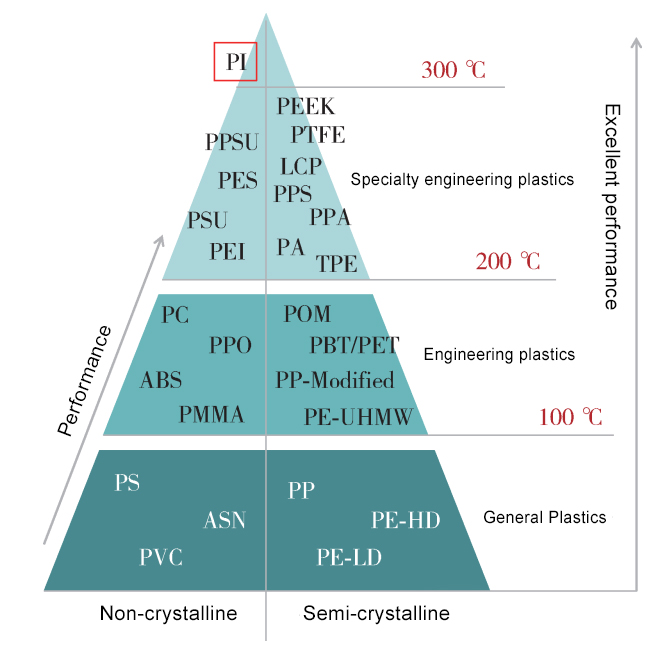
Figure 2. High-Performance Polymer Material Pyramid
The unique properties of polyimide can be summarized as follows:
(1) Thermal Decomposition Temperature
According to thermogravimetric analysis, the initial decomposition temperature of fully aromatic polyimides is generally around 500℃. Polyimides synthesized from biphenyl dianhydride and p-phenylenediamine have a thermal decomposition temperature of 600℃, making them one of the most thermally stable polymers to date.
(2) High Temperature Resistance
It can withstand temperatures above 400℃, with a long-term operating temperature range of -200 to 300℃ and no obvious melting point.
(3) Extreme Low Temperature Resistance
It can withstand extremely low temperatures, such as remaining brittle in liquid hydrogen at an absolute temperature of 4K (-269℃).
(4) Mechanical Properties
The tensile strength of unfilled polyimides is above 100 MPa. Kapton polyimide film has a strength of 250 MPa, while Upilex-S polyimide film reaches 530 MPa. As an engineering plastic, its elastic modulus is typically 3-4 GPa. Russian researchers have reported that fibers spun from copolymerized polyimides can achieve strengths of 5.1-6.4 GPa and moduli of 220-340 GPa. Theoretical calculations show that polyimide fibers synthesized from pyromellitic dianhydride and p-phenylenediamine can achieve a modulus of up to 500 GPa, second only to carbon fiber.
(5) Hydrolysis Resistance
Polyimides are relatively stable to dilute acids, but most varieties are not very resistant to hydrolysis, especially alkaline hydrolysis. This seemingly disadvantageous property gives polyimide a significant advantage over other high-performance polymers: the ability to recover dianhydrides and diamines from its raw materials via alkaline hydrolysis. For example, the recovery rate for Kapto films can reach 90%. Modifying the structure can also yield varieties with considerable hydrolysis resistance, even after boiling in water at 120°C for 500 hours. However, like other aromatic polymers, polyimide is not resistant to concentrated sulfuric acid, nitric acid, and halogens.
(6) Acid and Solvent Resistance
Polyimide has a broad solubility spectrum. Depending on its structure, some varieties are almost insoluble in all organic solvents, while others are soluble in common solvents such as tetrahydrogen, acetone, chloroform, and even toluene and methanol. Like other aromatic polymers, polyimide is not resistant to concentrated sulfuric acid, nitric acid, and halogens.
(7) Coefficient of Thermal Expansion
The coefficient of thermal expansion of polyimide is between 2x10⁻⁵ and 3x10⁻⁵ °C⁻¹, while that of biphenyl-type polyimide can reach 10⁻⁶ °C⁻¹, comparable to that of metals. Some varieties can even reach 10⁻⁷ °C⁻¹.
(8) Radiation Resistance
Polyimide exhibits high radiation resistance. Its films retain 86% of their strength even after absorbing a dose of 5x10⁷ Gy. A polyimide fiber retains 90% of its strength after irradiation with 1x10⁸ Gy electrons.
(9) Dielectric Properties
Polyimide possesses excellent dielectric properties. The dielectric constant of ordinary aromatic polyimide is around 3.4. Introducing fluorine, large side groups, or dispersing air at the nanoscale in polyimide can reduce the dielectric constant to around 2.5. The dielectric loss is 10⁻³, the dielectric strength is 100~300 kV/mm, and the volume resistivity is 10¹⁷ Ω·cm. These properties remain high over a wide temperature and frequency range.
(10) Flame Retardant Properties
Self-extinguishing: Polyimide generally does not spontaneously combust or support combustion, making it very safe for use in high-temperature environments; Low smoke emission: Polyimide exhibits extremely low smoke emission during high-temperature combustion, which helps reduce the release of smoke and toxic gases during a fire; High char residue: After high-temperature combustion, the char residue of polyimide is typically above 50%, which helps prevent further spread of fire.
(11) Biocompatibility
Polyimide is non-toxic and can be used to manufacture tableware and medical instruments, and can withstand thousands of sterilization cycles. Some polyimides also have excellent biocompatibility; for example, they are non-hemolytic in blood compatibility tests and non-toxic in in vitro cytotoxicity tests.
3. Polyimide - Applications
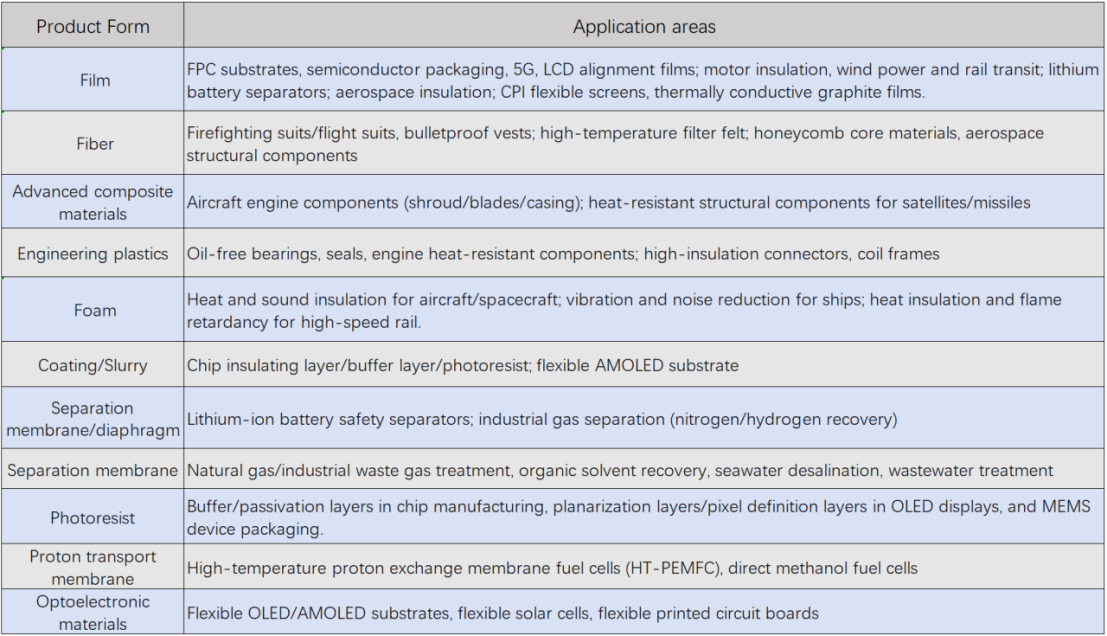
The typical processing model for general-purpose plastics and engineering plastics involves suppliers providing base resins, which are then processed into various products by manufacturers to supply the market. However, PI-related companies mostly integrate material synthesis and product molding, directly supplying products to the market. PI products come in various forms, including films, slurries, resins, fibers, foams, and composites (Table 1), boasting a high diversity of product types, ranking among the top polymer materials.
The polyimide market size is projected to reach US$5.46 billion in 2024 and is expected to reach US$7.6 billion by 2029, with a CAGR of 6.84% during the forecast period (2024-2029).
Table 1: Main Products and Application Areas of PI
Polyimide films are the earliest commercialized and largest form of PI product, typically produced by imidizing PAA slurry after casting. Conventional PI films are amber in color and possess excellent mechanical properties, dielectric properties, high and low temperature resistance, and radiation resistance, earning them the reputation of "golden films."
PI films include two types: pyromellitic polyimide films and biphenyl polyimide films. The former, produced by DuPont under the trade name Kapton, is made from pyromellitic tetracarboxylic anhydride and diaminodiphenyl ether. The latter, produced by Ube Industries, Ltd. under the trade name Upilex, is made from biphenyl tetracarboxylic dianhydride and diphenyl ether diamine (R-type) or m-phenylenediamine (S-type).
From a technical perspective, there are many types of PI films, including black PI films, brownish-yellow PI films, transparent PI films, and corona-resistant PI films. The latter three are mainly prepared using the chemical imide method and are the main application varieties in the high-end market.
According to different application categories, PI films can be divided into electrical PI films, electronic PI films, thermal control PI films, aerospace PI films, and CPI films for flexible displays.
(2) Fiber
Polyimide fiber is an important high-performance fiber. Its high-temperature resistant polyimide fiber is one of the organic synthetic fibers with the highest operating temperature, usable at 250~350℃. It is superior to aramid and polyphenylene sulfide fibers in terms of light resistance, water absorption, and heat resistance. The strength of high-performance polyimide fiber is about twice that of aramid, making it one of the organic synthetic fibers with the best mechanical properties.
The elastic modulus of polyimide fiber is second only to carbon fiber, making it a reinforcing agent for advanced composite materials. It can also be woven into ropes, fabrics, or non-woven fabrics for use in filtering high-temperature, radioactive, or organic gases and liquids, fireproof felts, fiber paper, bulletproof, and fire-retardant fabrics. The most well-known example is Lenzing's P84 polyimide fiber.
(3) Advanced Composite Material Matrix
Used in structural components and engine parts for aerospace, aircraft, and rockets. It can be used for hundreds of hours at 380℃ or higher, and can withstand short periods of 400~500℃, making it the most heat-resistant resin-based composite material. Carbon fiber/polyimide composites are widely used in the aircraft manufacturing industry. Carbon fiber reinforced composites with polyimide matrix materials such as BMI and PMR-15 can be used to produce aircraft engine cowlings, ventilation ducts, and engine fan blades.
(4) Engineering Plastics
These include both thermosetting and thermoplastic materials, and can be molded, injected, or transferred molded. They are mainly used for self-lubrication, sealing, insulation, and structural materials. Super engineering plastics, represented by DuPont's Vespel, can be used for long-term use over a very wide temperature range from low to high temperatures and have excellent wear resistance. Therefore, they can be used as components for aircraft engines, and are also applied in the automotive, satellite, and machinery industries.
(5) Coatings
They are used as insulating varnishes for electromagnetic wires or as high-temperature resistant coatings.
(6) Foamed Plastics
They are used as heat insulation and sound insulation materials for high and ultra-low temperatures.
(7) Separation Membranes
PI separation membranes are used for the separation of various gas pairs (such as hydrogen/nitrogen, nitrogen/oxygen, carbon dioxide/nitrogen, or methane), removing moisture from air, hydrocarbon feed gases, and alcohols. They can also be used in pervaporation membranes and ultrafiltration membranes. Due to the heat resistance and organic solvent resistance of polyimide, it is particularly important for the separation of organic liquids and gases.
(8) Photoresists
Like ordinary photoresists, photosensitive polyimides can be classified as negative or positive photoresists depending on the photochemical reaction mechanism. PI photoresists can now be developed with water-based solutions, achieving sub-micron resolution. Combined with pigments or dyes, they can be used in color filter membranes, greatly simplifying the processing steps. Currently, Siemens, DuPont, Ciba-Geigy, and Merck all offer such products.
(9) Proton Transport Membranes
Used as membranes in fuel cells, especially methanol fuel cells, their methanol permeability is significantly lower than that of traditional perfluorosulfonic acid membranes (Nafion).
(10)Optoelectronic materials
Used as passive or active waveguide materials, optical switch materials, etc., fluorinated polyimides are transparent in the communication wavelength range; using polyimides as a chromophore matrix can improve the stability of the material.
(11) Alignment for Liquid Crystal Displays
Polyimides play a very important role as alignment agents in TN-LCD, STN-LCD, TFT-LCD, and future ferroelectric liquid crystal displays.
(12) Applications in Microelectronic Devices
Used as a dielectric layer for interlayer insulation, as a buffer layer to reduce stress and improve yield. As a protective layer, it can reduce the impact of the environment on the device, and can also shield α-particles, reducing or eliminating soft errors in the device.
(13) Biocompatible Materials
The compatibility of fluorinated polyimides with blood and tissues has attracted interest in applications in biocompatible materials. PI is widely used in electrodes, biosensors, drug delivery systems, bone tissue substitutes, masks or respirators, and antibacterial materials.
(14) Adhesives
Used as high-temperature resistant adhesives. They possess excellent high-temperature mechanical properties, dielectric properties, and radiation resistance, and have been widely applied in high-tech fields such as aerospace and precision electronic machinery. They have also solved the problem of lower upper limit heat resistance temperatures found in other organic adhesives.
(15) Coatings
Due to their unique structure, polyimide polymer coatings are often used as heat-protective layers, waterproof and moisture-resistant layers, radiation-resistant layers, and other insulating layers. They have wide applications in industries such as aerospace, electronics, machinery manufacturing, and construction.


