


Basic Information & Characteristics
Aramid granules—also called Kevlar granules—are advanced polymer intermediates based on poly(p-phenylene terephthalamide) (PPTA). They are the feedstock for making aramid fiber, aramid paper, friction materials, and high-performance composites.
- Appearance: Light yellow to beige granules with uniform crystallinity
- Molecular structure: Rigid aromatic chains with strong hydrogen bonding and π–π stacking
- Thermal stability: Continuous service at 200–220 °C; short-term up to ~400 °C; decomposition >500 °C (inert)
- Key features: High tensile strength and modulus, low creep, excellent flame resistance, superior fatigue/radiation resistance, and chemical durability
Manufacturing Process
- Monomer preparation — p-Phenylenediamine (PDA) (impurities <50 ppm) and terephthaloyl chloride (TPC) (controlled moisture/byproducts).
- Polymerization — Conducted in concentrated H2SO4 or NMP/CaCl2 at −10 to 0 °C to obtain high-molecular-weight PPTA (intrinsic viscosity ≥ 5 dl/g).
- Precipitation & washing — Neutralization and removal of residual acids/salts.
- Drying — Vacuum drying to <0.5% moisture.
- Granulation — Spray drying or pelletizing to form uniform aramid granules (typ. 50–500 µm).
- Post-treatment — Surface modification (coupling agents, antistatic coats) and particle size classification per end-use.
Technical Parameters
| Property | Typical Value |
|---|---|
| Appearance | Light yellow, uniform granules |
| Density | 1.39–1.44 g/cm³ |
| Glass Transition (Tg) | ~370 °C |
| Melting Point | Does not melt; decomposes directly |
| Decomposition (Td) | >500 °C (N₂), ~450 °C (air) |
| Moisture Absorption | 3–7% (equilibrium) |
| Continuous Service Temp. | 200–220 °C |
| Mechanical (fiber form) | Tensile 2.8–3.6 GPa; Modulus 70–110 GPa; Elongation 2–4% |
| Electrical | Resistivity ~1015 Ω·cm; Dielectric constant ~3.4 |
| Chemical Resistance | Excellent vs. most solvents, weak acids/bases; poor in conc. H2SO4 or NaOH |
| Granule Size Range | 50–500 µm (customizable) |
Applications
Protective Equipment
Ballistic vests, cut-resistant gloves, helmets; firefighter and racing suits; high-strength ropes and reinforcement yarns.
Kevlar granules aramid fiberFriction & Sealing
Automotive brake pads and clutch linings; aerospace/high-speed rail braking; durable gaskets and seals.
friction materialsElectrical Insulation
Aramid paper for honeycomb cores, insulating boards, flexible circuits; motor slot insulation; heat-resistant tapes.
aramid paperPolymer Reinforcement
Enhancing thermoplastics (PA, PBT, PPS, PEEK, PEI) for lightweight aerospace structures and premium sports gear.
aramid compositesEmerging Uses
3D printing powders, electromagnetic shielding textiles, hydrogen storage tanks and composite cylinders.
PPTA granules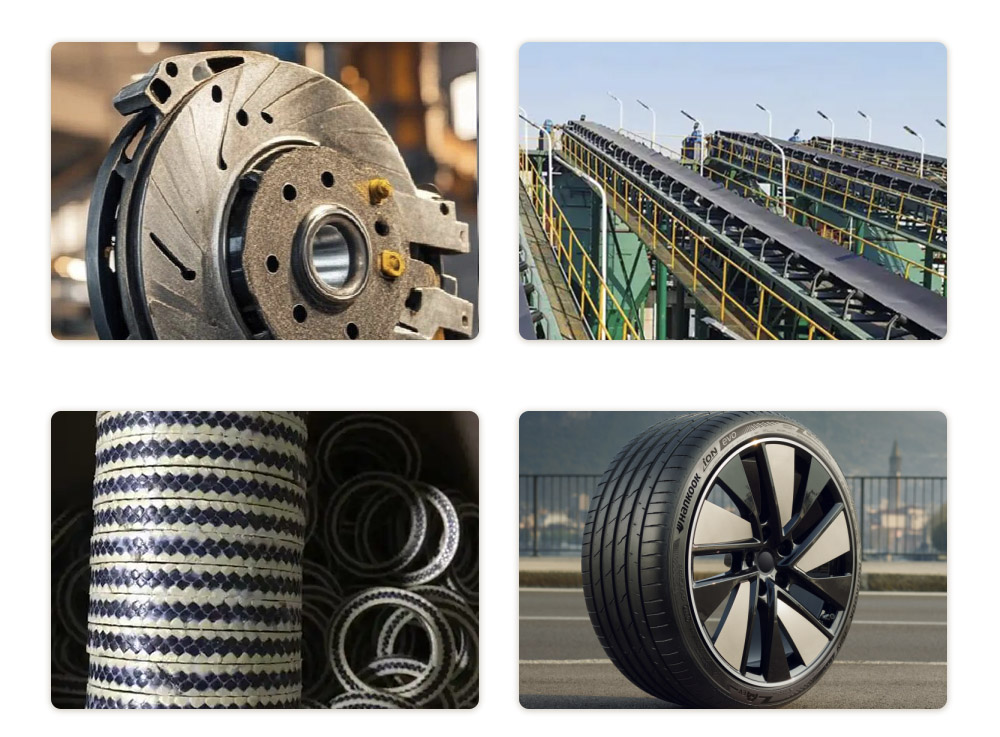
Future Outlook
- Aerospace & Defense: Increased substitution of metals with lightweight aramid composites in missiles, satellites, and aircraft.
- New Energy Vehicles: Reinforcement of battery separators and Type IV/V hydrogen storage tanks.
- Eco-friendly Processes: Transition from sulfuric acid routes to ionic liquids and greener solvents.
- Recycling: Growing chemical recycling of used Kevlar protective gear and aramid composites.
FAQ
What is the difference between aramid granules and Kevlar granules?
"Kevlar" is a well-known brand name for para-aramid fiber. In this context, aramid granules and Kevlar granules are commonly used interchangeably to describe PPTA-based granules used as raw materials.
Can aramid granules be customized?
Yes. Particle size distribution (e.g., 50–200 µm, 200–500 µm), moisture content, and surface treatments (coupling agents, antistatic) can be tailored to the end application.
Are aramid granules compatible with thermoplastics?
They can be compounded to reinforce PA, PBT, PPS, PEEK, and PEI, improving strength, wear resistance, and heat stability.
Tell us your target particle size, surface treatment, and end-use. We’ll respond with specs and lead time.
Contact & Sample Request
Email: anna@shenghetech.com · WhatsApp/WeChat:+86 15921909439


