


Aramid Honeycomb: Lightweight Nomex & Kevlar Core for Aerospace and Composites
Aramid honeycomb is a lightweight, high-strength honeycomb core made from aramid fibers like Nomex® or Kevlar®. Known for excellent mechanical strength, flame retardancy, and high-temperature performance, it is widely used in aerospace, rail transport, marine, and construction industries.
Basic Characteristics of Aramid Honeycomb
Material Composition
- Base Material: Nomex® (meta-aramid) or Kevlar® (para-aramid) paper impregnated with phenolic or polyimide resin
- Honeycomb Structure: Hexagonal, rectangular, or overexpanded cell design
- Density Range: 24–96 kg/m³ (1.5–6.0 lb/ft³)
Key Properties
- Lightweight & High Strength: Superior strength-to-weight ratio compared to aluminum honeycomb
- Temperature Resistance: Long-term use at 180–220°C; short-term up to 300°C
- Flame Retardancy: Limiting Oxygen Index (LOI) ≥ 28% (self-extinguishing)
- Impact Resistance: Excellent toughness and dynamic impact resistance
- Corrosion Resistance: Resistant to chemicals and humidity
- Dielectric Properties: Low dielectric constant, ideal for radar-transparent structures
Manufacturing Process of Aramid Honeycomb
Raw Material Preparation
Aramid paper sheets are impregnated with phenolic resin (standard) or polyimide resin (for higher temperature resistance).
Formation Process
- Adhesive Lamination: Sheets are coated with adhesive strips, stacked, hot-pressed (150–180°C), and expanded into honeycomb cells.
- Molding Method: Used for complex-shaped or curved honeycomb cores.
- Overexpanded Honeycomb: Stretched further for rectangular cells, enhancing shear performance.
Post-Processing
Surface treatment includes flame-retardant or moisture-proof coatings. CNC waterjet or laser cutting ensures precision dimensions.
Technical Parameters
| Parameter | Typical Value |
|---|---|
| Density (kg/m³) | 24, 32, 48, 64, 96 |
| Cell Size (mm) | 1.8, 3.2, 4.8, 6.4 |
| Compressive Strength (MPa) | 0.5–8.0 |
| Shear Strength (MPa) | 0.3–4.0 |
| Max Operating Temp. | 180°C (long-term), 300°C (short-term) |
| Thermal Conductivity (W/m·K) | 0.03–0.06 |
| Dielectric Constant | 1.1–1.5 |
Applications of Aramid Honeycomb
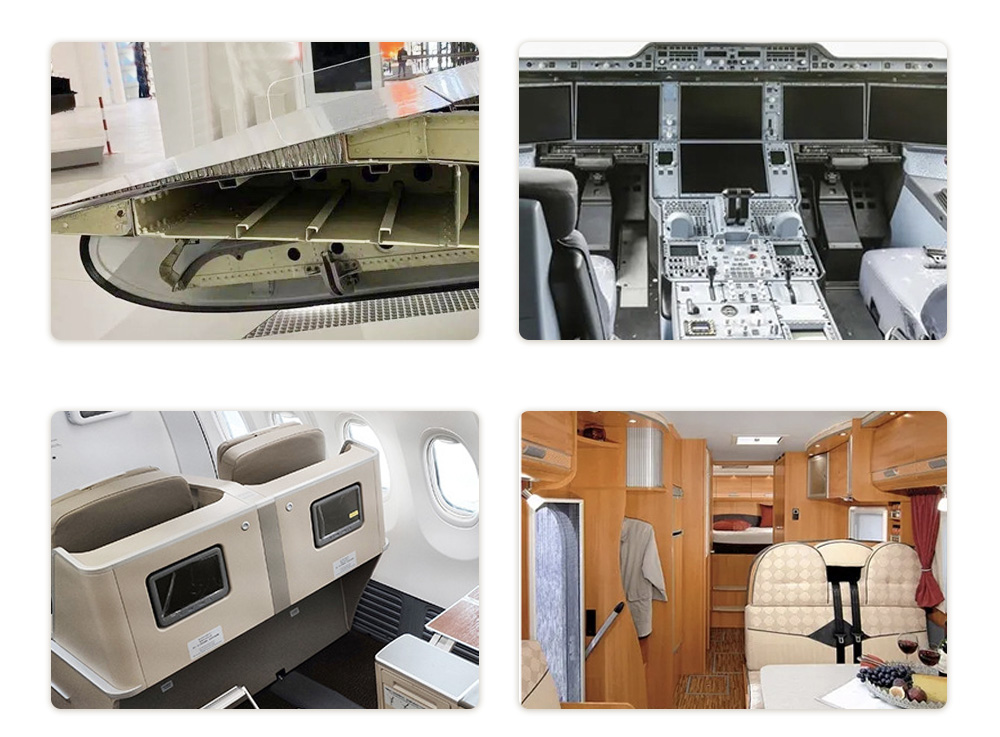
Aerospace
- Aircraft wings, floors, tail fins, and bulkheads
- Helicopter rotor blades, cabin partitions
- Satellite panels, rocket fairings (radar-transparent)
Rail Transportation
- High-speed train sidewalls, ceilings, and insulation
- Maglev train lightweight structures
Marine & Defense
- Ship decks, bulkheads, sonar domes
- Blast-resistant panels for armored vehicles
Construction & Renewable Energy
- Fire-resistant building facades
- Wind turbine blade cores
Other Uses
- Sports equipment: racing boats, F1 cars
- Electronics: 5G radomes
Comparison with Other Honeycomb Materials
| Property | Aramid | Aluminum | Fiberglass | Carbon |
|---|---|---|---|---|
| Density | Low | Medium | Low | Low |
| Strength | High | High | Medium | Very High |
| Heat Resistance | Excellent | Poor | Moderate | Excellent |
| Flame Retardancy | Excellent | Poor | Good | Excellent |
| Cost | Medium-High | Low | Medium | Very High |
Conclusion
Future developments include polyimide-based aramid honeycombs with higher heat resistance, multifunctional cores (conductive, radar-absorbing, self-healing) and greener manufacturing with recyclable resin systems. With its superior strength, low weight, heat resistance and flame retardancy, aramid honeycomb is a key core material for advanced composite structures in aerospace, rail, marine and many other industries.


