Para-Aramid Woven Tape (Kevlar Tape): High-Performance "Golden Fiber" Material
Para-aramid woven tape, commonly known as Kevlar tape, is a high-performance synthetic fiber webbing, often referred to as the “golden fiber” due to its exceptional properties. Para-aramid (poly(p-phenylene terephthalamide)) is a high-strength, high-modulus, heat-resistant synthetic fiber. Structurally composed of aromatic rings and amide groups in a linear polymer chain, it is processed into Kevlar fabric tape or Kevlar cloth tape through specialized weaving techniques.
Core Properties
- Outstanding Mechanical Strength: Its specific tensile strength is six times that of steel wire, and its tensile modulus is three times higher. These properties make Kevlar cutting tape ideal for high-stress applications.
- Excellent Heat and Flame Resistance: Operates continuously from -196°C to 204°C; remains stable at 560°C without decomposing or melting. It does not drip or self-ignite when exposed to flame.
- Durability: Resistant to abrasion, cutting, aging, UV radiation, and moisture, offering a long service life. Black Kevlar tape variants provide both durability and aesthetic compatibility.
- Electrical Insulation: Provides reliable dielectric performance.
- Lightweight: Delivers the same strength as many traditional materials at significantly lower weight.
Manufacturing Process
The production of Kevlar tape black or colored variants integrates advanced materials science with precision engineering, typically involving the following steps:
- Fiber Preparation: Para-aramid fibers are produced through low-temperature solution polycondensation and dry-jet wet spinning. Key factors include controlling molecular weight distribution, orientation during spinning, and post-treatment conditions (washing and drying) to optimize crystallinity and mechanical performance.
- Yarn Preparation: Continuous para-aramid filaments are twisted or plied into yarns. For certain applications (e.g., conveyor belts), yarns may be aligned in parallel at specific spacing (7–10 mm) and fixed under controlled tension (2.94–4.9 N).
- Weaving: Yarns are woven on dedicated looms into tapes of specified width and thickness, using structures such as tubular webbing. The resulting 3M Kevlar tape can meet industrial and safety standards.
- Post-Treatment and Composite Reinforcement (Optional):
- Surface treatments may be applied to enhance performance or texture.
- Reinforcement can be achieved by laminating yarns with thermoplastic polyurethane (TPU) via calendering, or with waterborne polyurethane (WPU) under controlled temperature (~180°C), pressure (~19.6 MPa), and processing speed for composite strengthening.
Technical Parameters
| Property |
Typical Value |
Notes/Source |
| Tensile Strength |
≥ 20.5 cN/dtex |
Fiber standard |
| Elongation at Break |
≥ 3.5% |
High-elongation fibers |
| Initial Modulus |
80–88 GPa |
High-elongation, low-modulus type |
| Continuous Service Temp. |
-196°C to 204°C |
Stable range |
| High-Temp Stability |
No decomposition/melting at 560°C |
- |
| Flame Retardancy |
No melting/dripping; non-flammable; meets UL94 V-0 |
- |
| Common Widths |
14 mm, 19 mm, 25 mm, 28 mm, 31 mm, 37.5 mm, 44 mm, 50 mm |
- |
| Weight Range (per unit length) |
e.g., 44 mm width: 5.3–77.5 g/m |
Varies by width |
| Colors |
Black, gray, etc. |
Compatible with vehicle interiors; black Kevlar tape is widely used |
Limitations
- Chemical Resistance: Performance may be affected by some organic solvents.
- UV Degradation: Prolonged exposure to strong UV light can reduce strength; protective coatings or UV-resistant grades are recommended.
- Cost: Higher than many common synthetic fibers.
Applications
The unique properties of Kevlar tape make it indispensable in demanding fields, including:
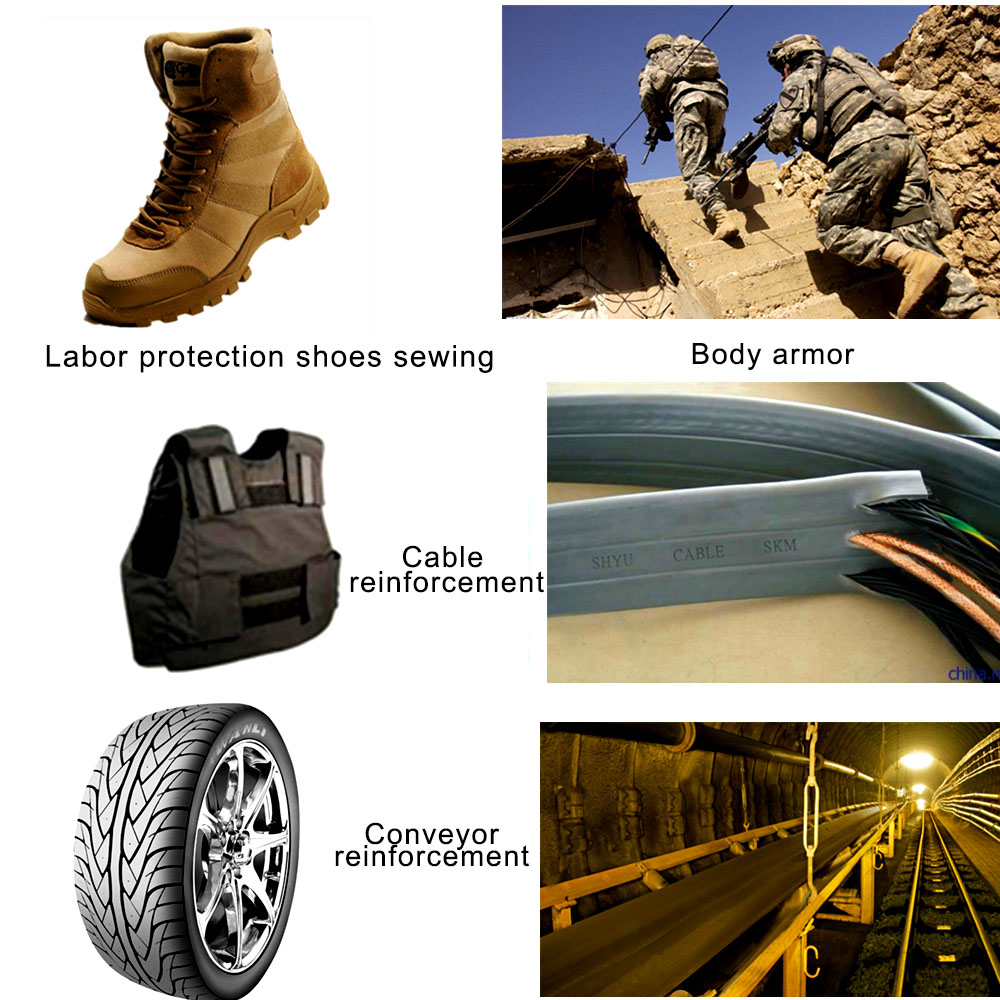
- Personal Protective Equipment (PPE): Safety harnesses, lifelines, ballistic vests, and helmets, where high strength and flame resistance are critical.
- Industrial Transmission and Power Systems: High-performance conveyor belts (especially in food-grade, abrasion-resistant applications), tire cord, automotive hoses, and other products requiring strength and dimensional stability. Kevlar fabric tape is often used in these contexts.
- Transportation: Hand straps and webbing in buses, subways, and trains, valued for their flame resistance, durability, and comfortable grip. Kevlar cloth tape provides both safety and comfort.
- Military and Aerospace: Equipment such as MIL-W-87127-compliant tubular webbing, parachute harnesses, and armor reinforcement, designed for extreme environments.
- Electrical and Electronics: Used where insulation and thermal resistance are required.
- Ropes and Outdoor Equipment: High-strength, lightweight lifting slings, climbing ropes, and sailing ropes. Kevlar cutting tape ensures reliable performance in these applications.
Conclusion
Kevlar tape, including black Kevlar tape, is a high-tech material that balances strength, thermal stability, flame resistance, and long-term durability. Despite its relatively high cost, it is often the irreplaceable choice for applications demanding safety, reliability, and performance. With continuous technological advancements and expanding applications, the importance of Kevlar tape, 3M Kevlar tape, and related products will continue to grow.


