


Introduction to Para-Aramid Powder
Chemical name: Poly(p-phenylene terephthalamide), abbreviated as PPTA.
Appearance: Light yellow to light brown powder, also obtainable by mechanical pulverization of aramid fibers.
Key Features:
- High tensile strength (specific strength more than 5 times that of steel)
- High modulus (comparable to carbon fiber)
- Excellent thermal resistance (decomposition temperature ≥ 500℃, continuous operating temperature 200–250℃)
- Outstanding electrical insulation and chemical resistance
- Self-extinguishing (LOI > 28, flame-retardant)
Compared with para-aramid fibers, aramid powder offers easier dispersion in resins and rubber, making it a preferred reinforcing filler and functional modifier.
Manufacturing Process
Two main routes typically prepare para-aramid powder:
(1) Polymerization Route
- Monomers: Terephthaloyl chloride (TPC) and p-phenylenediamine (PDA)
- Polymerization: Conducted via low-temperature solution polycondensation (common solvents: NMP/CaCl₂, DMSO/CaCl₂)
- The resulting para-aramid polymer is precipitated, washed, dried, and pulverized into powder.
- Pros: Controllable particle size, high purity
- Cons: High synthesis cost
(2) Fiber Pulverization Route
- Commercial para-aramid fibers (Kevlar, Twaron, or domestic grades such as Taparan) are mechanically ground, often by cryogenic pulverization.
- Pros: Simple process, suitable for mass production
- Cons: Broader particle size distribution, relatively low surface activity
(3) Surface Modification
To improve interfacial compatibility with resin/rubber matrices, surface treatments are commonly applied:
- Plasma treatment
- Coupling agents (e.g., silane, titanate)
- Coatings (e.g., epoxy, polyimide)
Technical Parameters
Performance depends on particle size and surface treatment. Typical values are:
| Property | Typical Value Range |
|---|---|
| Average particle size (D50) | 1–20 μm (adjustable) |
| True density | 1.44 g/cm³ |
| Specific surface area | 1–10 m²/g |
| Tensile strength (based on fiber) | 2.8–3.6 GPa |
| Tensile modulus | 60–120 GPa |
| Thermal decomposition temperature | ≥ 500 ℃ |
| Glass transition temperature (Tg) | No distinct Tg, highly crystalline polymer |
| Limiting oxygen index (LOI) | 28–30 |
Applications
Para-aramid powder serves as a reinforcing filler and performance enhancer in multiple industries:
(1) Resin Reinforcement
- Applied in epoxy, phenolic, and polyimide systems
- Enhances impact strength, wear resistance, and flame retardancy
- Used in aerospace structural components, electronic packaging materials
(2) Friction and Sealing Materials
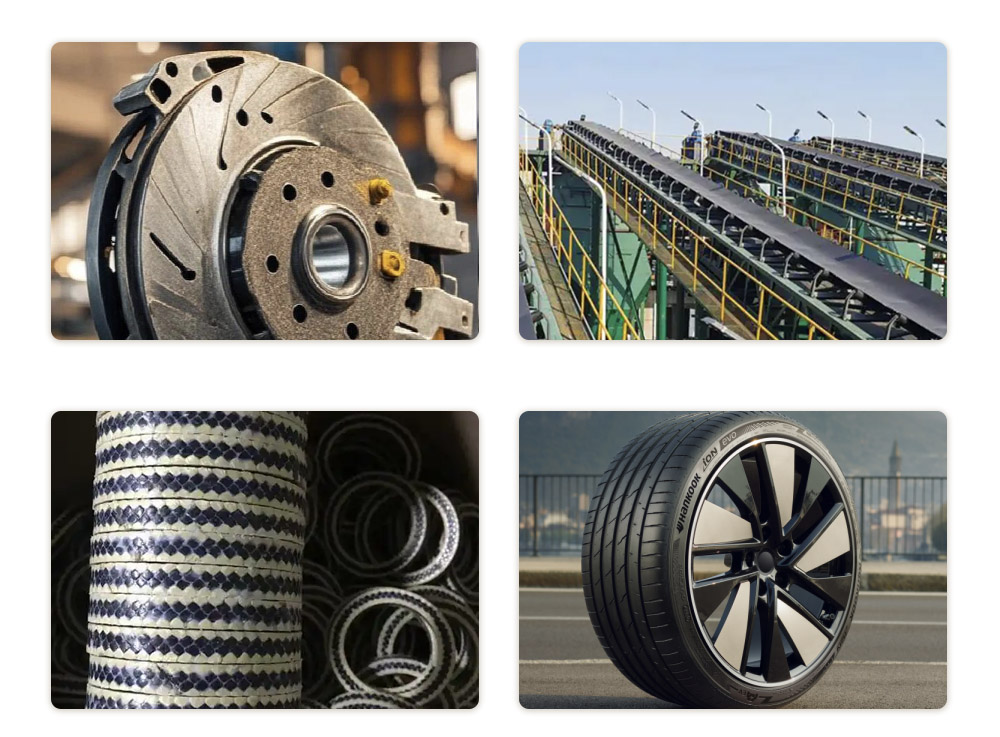
- Automotive brake pads, clutch facings, and aircraft braking systems
- Replaces asbestos with superior heat resistance and safety
(3) Rubber Reinforcement
- Tires, conveyor belts, and sealing gaskets
- Improves wear resistance, tear resistance, and thermal aging performance
(4) Composite Materials
- Hybrid with carbon fiber, glass fiber to form lightweight, high-strength composites
- Applications in sports equipment, ballistic armor, and aerospace structures
(5) Electronics & Electricals
- Used as an insulating filler in coatings and films
- EMI shielding and 5G antenna material reinforcement
Future Outlook
Due to its high strength, thermal resistance, flame retardancy, and eco-friendliness, para-aramid powder has broad prospects:
- Asbestos replacement: Eco-regulations are accelerating substitution in friction materials.
- New Energy Vehicles (NEVs): Applied in battery separators, braking systems, and lightweight structures.
- 5G and Electronics: Increasing role in high-frequency, high-speed substrates (e.g., PCBs, radomes).
- Aerospace: Usage in engine seals, wear-resistant components, and lightweight composites.
- Advanced Composites: Growing demand in hybrid carbon/aramid composites for toughness enhancement.
Global market forecasts suggest para-aramid powder demand will grow at a CAGR of 8–12% over the next 5–10 years, with core applications in NEVs, aerospace, and 5G communication materials.


