PBO Fabric-Plain | PBO Fabric for Sale | PBO Fabrics
PBO plain weave fabric (also known as PBO fabric-Plain) is a high-performance textile material made from PBO fibers (poly(p-phenylene-2,6-benzobisoxazole)) through a plain weave process. It is hailed as the “super fiber of the 21st century.” Many flame retardant fabric manufacturers and flame retardant fabric suppliers now provide PBO fabrics to meet the growing flame retardant fabric market demand.
Manufacturing Process of PBO Fiber Fabric
The production of PBO fiber fabric mainly includes two key stages: fiber preparation and fabric weaving.
1. PBO Fiber Preparation – a precise process with high technical barriers
Monomer synthesis and polymerization: Typically, 4,6-diaminoresorcinol (DAR) hydrochloride and terephthalic acid (TPA) are used as the main monomers. These undergo solution polycondensation in polyphosphoric acid (PPA). PPA serves both as a solvent and as a polycondensation catalyst. Strict conditions must be maintained to obtain high-molecular-weight PBO polymer.
Fiber spinning: A dry-jet wet spinning process is employed. The liquid-crystalline PBO polymer solution is degassed and filtered before being extruded through spinnerets. The filaments first pass through a short air gap (dry-jet) and then solidify in a coagulation bath (wet spinning). The as-spun fibers (AS grade) already exhibit highly oriented molecular chains, so no drawing is required. For higher modulus fibers, tension heat treatment above 600 °C is applied, producing HM (high-modulus) fibers that typically display a golden metallic sheen.
2. Fabric Weaving – using PBO filament yarns as raw materials
Warp preparation: 100–300D PBO filament yarns are selected for both warp and weft. Warp yarns are usually twisted (about 230 twists/meter) to enhance cohesion and weaving performance.
Weft preparation: Weft yarns are generally untwisted and wound into bobbins suitable for shuttle weaving.
Weaving: Plain weave structure is used, the most basic weave in which warp and weft yarns interlace alternately (over one, under one). This ensures structural stability and surface smoothness of the fabric. By adjusting warp/weft density and yarn fineness, fabric thickness, weight, and mechanical properties can be tailored.
This makes PBO flame fabric and flame retardant fabric material highly customizable, with options available for buyers searching to buy flame retardant fabric or explore flame retardant fabric for sale from trusted flame retardant fabrics suppliers.
Properties of PBO Flame Fabric
The core advantages of PBO flame fabric lie in its extreme mechanical strength, exceptional thermal stability, and outstanding flame retardancy.
- Unmatched strength and stiffness: PBO fibers exhibit ultra-high strength and modulus. Their strength exceeds that of steel fibers and T800 carbon fibers, while their modulus is about twice that of para-aramid fibers (e.g., Kevlar). A single 1 mm PBO filament can lift 450 kg, making it a true high strength fabric and high tensile strength fabric.
- Superior thermal stability: With a decomposition temperature up to 650 °C, PBO fibers remain stable under high temperatures. At 316 °C, they retain their mass after 100 hours, and they can operate at around 330 °C. They have no melting point and do not soften at high temperatures.
- Extreme flame resistance: With a limiting oxygen index (LOI) of 68%, PBO is an inherently flame retardant fabric. It does not shrink when exposed to flame, and once the flame is removed, there is essentially no afterglow. This makes it one of the most reliable flame retardant fabrics for protective industries.
- Good chemical resistance: PBO fibers show excellent resistance to chemicals, dissolving only in a few strong acids such as concentrated sulfuric acid or polyphosphoric acid.
- Weaknesses: The main limitations of PBO fibers are relatively poor compressive strength and surface adhesion, along with high sensitivity to UV and visible light. Protective measures or modifications are needed for outdoor or exposed use.
Technical Data of PBO Fabric-Plain
| Property Category |
Parameter |
Typical Value/Range |
Remarks |
| Mechanical |
Tensile strength |
37 cN/dtex (AS), higher for HM |
>10× that of steel fiber |
|
Elastic modulus |
1150 cN/dtex (AS), 1720 cN/dtex (HM) |
~2× higher than para-aramid |
|
Elongation at break |
3.5% (AS), 2.5% (HM) |
|
| Physical |
Density |
1.54–1.56 g/cm³ |
Lighter than carbon fiber (1.80–1.87 g/cm³) |
|
Linear density |
100–300D |
For warp & weft |
| Thermal |
Decomposition temp. |
~650 °C |
Stable at 316 °C for 100 h |
|
LOI (Limiting Oxygen Index) |
68% |
Fabric flame retardant |
|
Continuous service temp. |
~330 °C |
|
| Fabric Parameters |
Weave type |
Plain weave |
Also twill possible |
|
Basis weight |
300–1000 g/m² |
Customizable |
|
Thickness |
1–25 mm |
Customizable |
| Other |
Color |
Yellow–orange (HM shows metallic gold sheen) |
|
|
UV sensitivity |
High |
Protection required |
Applications of PBO Flame Retardant Fabrics
Thanks to its extraordinary properties, PBO flame retardant fabric (and its fibers) is widely used in high-tech industries and advanced protective applications.
Aerospace & Defense
- Stratospheric airship skins, rocket casings, aircraft black box housings (transparent to radio signals, seawater-resistant, flame-resistant, impact-tolerant).
- Military protection: bulletproof vests, helmets, plates, and armor.
- High-performance flight suits.
Advanced Protective Gear
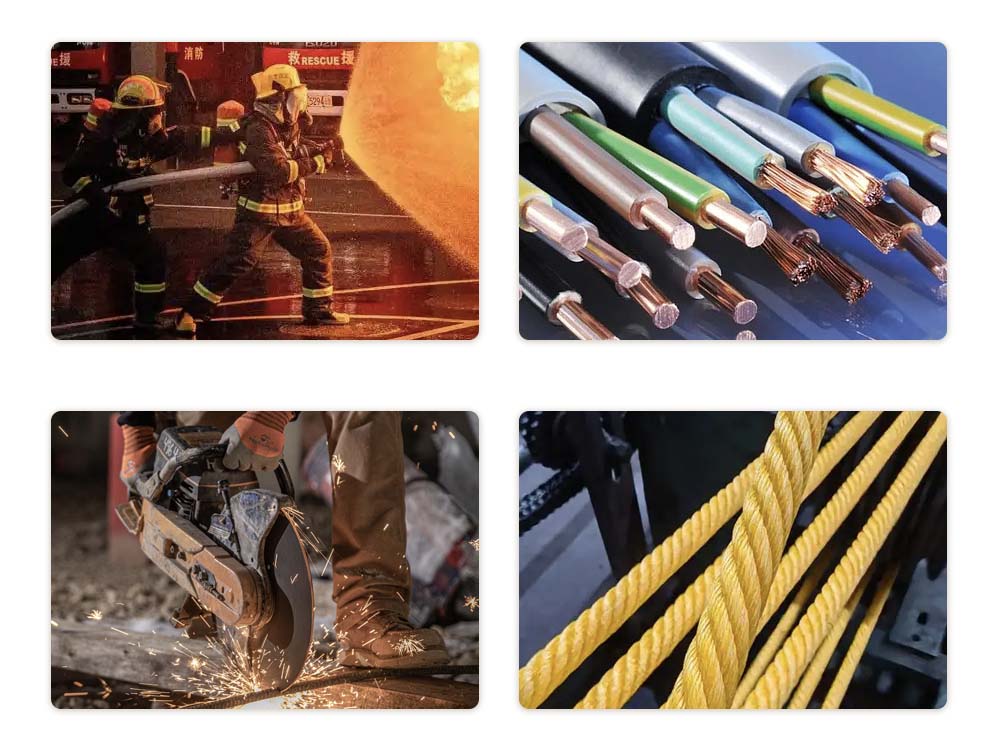
- Turnout flame fabric yard PBO: widely applied in firefighting suits and other fire service equipment.
- Flame retardent fabric for heat-resistant workwear (furnace operators, welders, molten metal environments).
- Flame retardant material fabric used in anti-cutting gear: gloves, protective clothing, safety shoes.
Industrial & Environmental Applications
- High-temperature filtration media such as bag filters for dust collection in steel, cement, and waste incineration.
- Reinforcement in friction materials (brake pads), sealing gaskets, and resins.
Sports & Leisure Equipment
- Tennis rackets, speedboats, racing shells, loudspeaker diaphragms, golf clubs, skis, surfboards, bowstrings, bicycles, etc.
Composite Reinforcement
- Tires, belts, hoses, plastics, and concrete reinforcement.
- Fiber optic strength members and protective sheaths.
- Bridge cables and building reinforcement.
Other Specialized Uses
- Corrosion-resistant protective clothing, high-temperature balloon materials, electrical insulation, satellite components, lightweight automotive parts, and deep-sea oilfield applications.
Flame Retardant Fabric Market & Supply
With the rapid growth of the flame retardant fabric market, demand for PBO fabric for sale continues to increase. Many flame retardant fabric suppliers and flame retardant fabrics suppliers are focusing on inherently flame retardant fabric like PBO due to its durability and safety performance. If you are looking to buy flame retardant fabric with unmatched strength, heat resistance, and non-flammability, PBO is among the most advanced options available.


