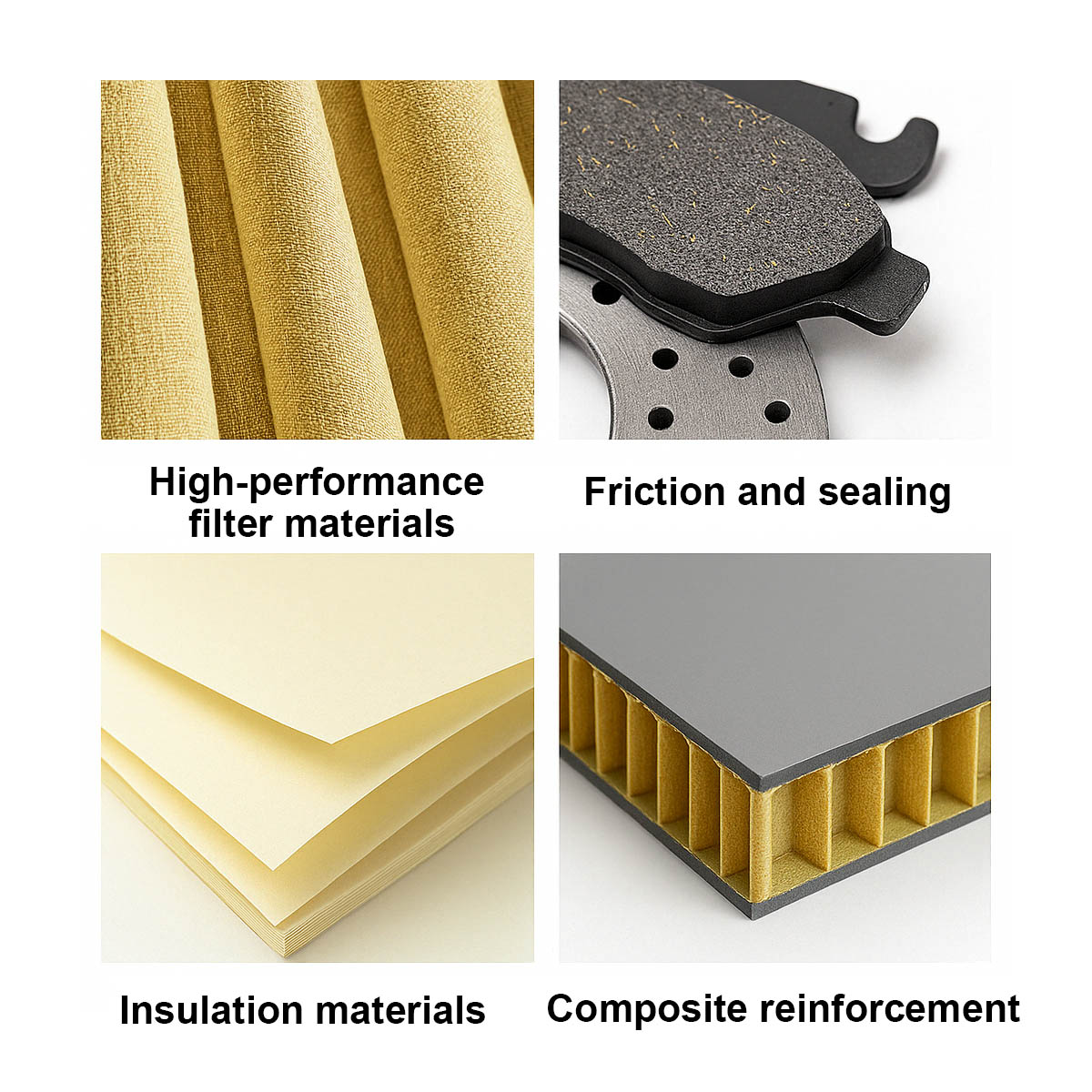
Precipitated meta-aramid fiber is a specialized material produced through fibrillation of meta-aramid fibers (e.g., Kevlar®). It features a highly branched fibrous structure and an exceptionally large specific surface area. Key manufacturing methods include jet spinning (where polymer fluid is mixed with coagulants to form film-like pulp) and mechanical fibrillation (using mechanical beating to split fibers into nanoscale fibrils). Renowned for its reinforcement capabilities, thermal resistance, and processability, aramid wet pulp serves as an eco-friendly substitute for asbestos in applications such as friction/sealing materials, composites, and insulation paper.
Precipitated Meta-aramid Fiber Properties
- Thermal Stability: Operates reliably from -200°C to +350°C without softening or decomposition.
- Mechanical Strength: High toughness and tensile strength, with stable aspect ratios during processing, significantly enhancing tensile and tear resistance in composites.
- Surface Characteristics: Fibrillated structure creates a "fluffy" surface, achieving a specific surface area of 5–15 m²/g for superior interfacial bonding.
- Chemical Resistance: Resists acids, alkalis, and corrosive environments.
- Processability: High water retention (e.g., 5.6 g/g in certain studies), enabling dense fiber networks in wet papermaking for improved sheet density and strength.
Precipitated Meta-aramid Fiber Applications
- Friction & Sealing: Used in automotive brake pads, clutch plates, and gaskets as a high-wear, asbestos-free solution.
- Composite Reinforcement: Enhances impact resistance and dimensional stability in epoxy/rubber composites for aerospace components.
- Insulation Materials: Produces heat-resistant insulation paper for electrical equipment or spacecraft thermal barriers.
- Adhesives & Sealants: Acts as a thickener and reinforcement agent to boost bonding strength and aging resistance.
Technical Specifications
Typical metameters of aramid wet pulp (varies by manufacturer):
| metameter |
Range / Value |
Notes |
| Density |
1.41–1.45 g/cm³ |
ASTM D792 |
| Specific Surface Area |
5–15 m²/g |
BET method |
| Fiber Length |
0.5–2.5 mm |
ISO 16065-2 |
| Operating Temperature |
-200°C to +350°C |
Thermal gravimetric analysis |
| Bulk Density |
3–10 lb/ft³ (48–160 kg/m³) |
ASTM D1895 |
| Moisture Regain |
≤8% |
ISO 287 |
| Tensile Index (paper) |
50–70 N·m/g |
TAPPI T494 |
Precipitated Meta-aramid Production & Optimization
Fibrillation: Mechanical grinding splits fibers into nanofibrils, increasing surface area and bonding.
Surface Modification: Introduces reactive groups (e.g., amino) to strengthen hydrogen bonding with resins.
Dynamic Drainage Control: Film-type pulp requires optimized mesh screens (e.g., 200-mesh) for tailored dewatering rates.
Research advances
Recent studies highlight jet-spun pulp with ultra-thin films (e.g., 58 nm thickness, 9.2 m²/g surface area) and nanofibril-enhanced tear resistance in paper. Surface activation (e.g., hydrophobic treatment) expands its use in high-temperature protective coatings.


