Aramid–silicone composites combine the high tensile strength and heat resistance of aramid fibers (like Kevlar®, Twaron®) with the weatherability, flexibility, and electrical insulation of silicone rubber. This unique material is rapidly becoming essential in protective equipment, industrial sealing, electronics, aerospace, and next-generation smart wearables.
What Are Aramid–Silicone Composites?
An aramid–silicone composite is a hybrid material that bonds aramid fiber (a high-strength, high-modulus synthetic fiber) with a silicone rubber coating. This combination delivers superior mechanical strength, temperature stability, flame retardancy, and chemical resistance, making it ideal for demanding and harsh environments.
Key Advantages and Unique Properties
- High Strength and Modulus: Aramid fibers such as Kevlar® can reach tensile strengths over 3.0 GPa.
- High Temperature Resistance: The composite operates continuously above 200°C, with short-term peaks up to 500°C.
- Chemical & Flame Resistance: Inherently flame-retardant (LOI ≥28) and resistant to oils, mild acids, and alkalis.
- Superior Flexibility: Silicone rubber keeps the material pliable, even in extreme cold (down to -60°C) or heat (up to 250°C).
- Electrical Insulation: High dielectric strength (≥20 kV/mm) and volume resistivity (>10¹⁵ Ω·cm).
- Environmental Protection: Outstanding UV resistance and aging stability extend service life in outdoor or high-exposure uses.
How Aramid–Silicone Composites Are Manufactured
The typical manufacturing process involves:
- Aramid Fiber Pretreatment: Surface cleaning (plasma or solvents) and chemical activation (silanes) to improve silicone adhesion.
- Silicone Coating: Methods include dipping, spraying, or calendaring to apply a silicone layer of 0.1–2.0 mm.
- Curing: Heat or room-temperature vulcanization (RTV) forms a crosslinked structure.
- Post-Treatment: Cutting, adding textures, or shaping to meet custom requirements.
Key challenges include ensuring strong fiber–silicone bonding and maintaining coating uniformity.
Typical Technical Specifications
| Parameter | Typical Value |
|---|
| Tensile Strength | ≥50 MPa |
| Service Temperature | -60°C to +250°C |
| Silicone Thickness | 0.1–2.0 mm |
| Flame Retardancy | UL94 V-0 |
| Dielectric Strength | ≥20 kV/mm |
| Chemical Resistance | Oil, mild acids, alkalis |
Application Fields of Aramid–Silicone Materials
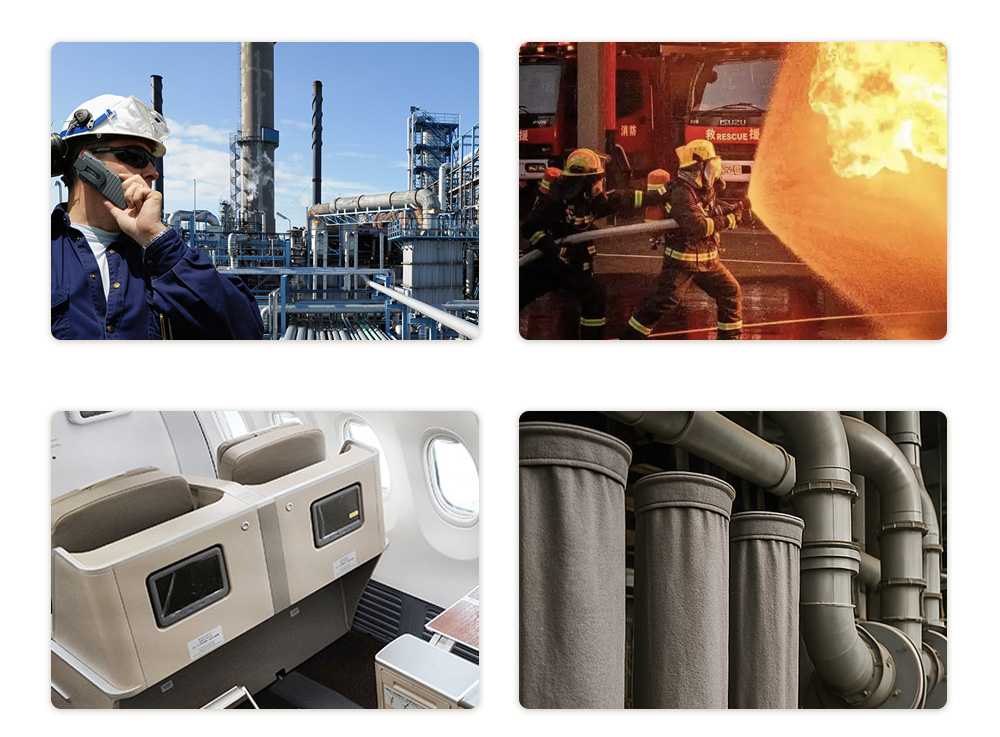
Protective Equipment: Firefighting suits, cut-resistant clothing, heat-resistant gloves.
Industrial Sealing: High-temp gaskets for petrochemical pipelines and engines.
Electronics: Insulating sleeves for cables and EV battery packs.
Aerospace: Lightweight thermal insulation for aircraft engines.
Sports & Safety Gear: Climbing ropes and safety harnesses with improved grip and load-bearing.
Latest Trends and Innovations
Modern aramid–silicone composite technology is evolving with:
- Water-based and bio-based silicones to reduce VOCs and meet REACH and RoHS standards.
- Extreme temperature adaptability using ceramic nanoparticle additives.
- Multi-functional coatings for EMI shielding, self-healing, and hydrophobic surfaces.
- Lightweight miniaturization with nano-spraying and honeycomb structures.
- Smart integration of sensors, energy harvesting, and color-changing properties.
- 3D printing and AI-driven process control for customized, efficient production.
Future Development and Industry Outlook
Driven by sustainability and high-performance demands, aramid–silicone composites are expanding into new energy, biomedical, flexible electronics, deep-sea cables, and smart IoT-integrated protective gear. Despite challenges in cost and process complexity, innovations in upstream high-purity aramid fibers, functional silicones, and downstream co-development with end-users promise continued growth and breakthroughs.


