Polyurethane + aramid fiber timing belts with high heat resistance, strength, and durability for industrial power transmission systems.
High-Temperature Resistance of Polyurethane + Aramid Fiber Timing Belts
Polyurethane + aramid fiber timing belts combine the elasticity and wear resistance of polyurethane with the high strength and heat resistance of aramid fibers, making them suitable for transmission systems operating under high-temperature conditions. The thermal resistance of aramid fibers (continuous use temperature up to 200 °C) significantly enhances the belt’s overall heat resistance, while modified polyurethane resin matrices can remain stable at elevated temperatures. This article analyzes their high-temperature performance from four aspects: material properties, heat-resistance mechanisms, influencing factors, and optimization methods.
Material Properties and Heat-Resistance Mechanism
Polyurethane Matrix Properties
Conventional polyurethane has a long-term service temperature range of –40 °C to 80 °C, and can withstand up to 100 °C in the short term.
Through modification (e.g., adding heat stabilizers), polyurethane resin thermal resistance can be improved to 120 °C–150 °C.
Aramid Fiber Properties
Aramid fibers (such as Kevlar) possess excellent heat resistance, with a continuous use temperature up to 200 °C and short-term tolerance up to 250 °C.
Their thermal decomposition temperature exceeds 500 °C, and they retain high tensile strength (~3000 MPa) and high modulus (~70 GPa) even at elevated temperatures.
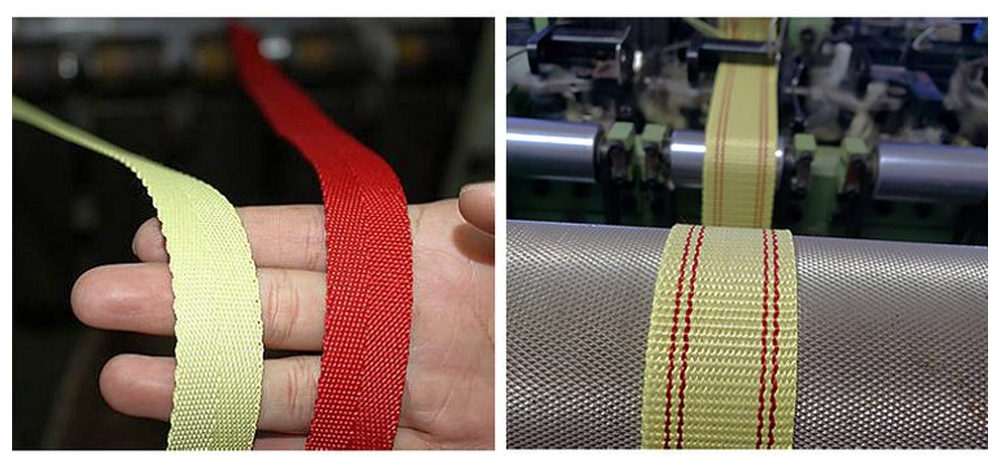
When used in Aramid belts, Aramid conveyor belts, or Aramid cord belts, they provide outstanding mechanical reinforcement and thermal stability.
Heat-Resistance Mechanism
Aramid fibers act as the reinforcing layer, maintaining mechanical performance and bearing the main load under high temperatures.
Modified polyurethane resin matrices, enhanced with heat stabilizers and cross-linked structures, delay softening and decomposition at high temperatures.
Key Factors Affecting Heat Resistance
Polyurethane Matrix Heat Resistance
- Conventional polyurethane softens easily at high temperatures and requires modification.
- Adding stabilizers (e.g., antioxidants, UV absorbers) can slow down thermal aging.
Aramid Fiber Content and Distribution
- Increasing aramid fiber content improves overall thermal resistance but reduces flexibility.
- Uniform fiber distribution enhances load transfer efficiency at high temperatures.
Interfacial Bonding Strength
- Poor bonding at high temperatures can cause delamination and failure.
- Surface treatments (e.g., plasma treatment) can optimize bonding.
Operating Conditions
Oxidation, moisture, and chemical media in high-temperature environments accelerate aging, requiring protective measures.
Methods to Improve Heat Resistance and Applications
Polyurethane Matrix Modification
Add heat stabilizers and cross-linking agents to enhance thermal resistance and stability.
Optimization of Fiber Content and Distribution
Design fiber content reasonably (typically 30%–40%) to ensure reinforcement effectiveness under high temperatures.
Improving Interfacial Bonding
Apply surface treatments to aramid fibers (e.g., silane coupling agents) to improve bonding with polyurethane.
Application Scenarios
- High-temperature transmission systems: metallurgy equipment, drying systems.
- High-load transmission: construction machinery, mining equipment, where Aramid cord belts are often used for strength and reliability.
- High-speed transmission: textile machinery, printing equipment, where Aramid belts and modified polyurethane resin provide stable performance under heat.
Conclusion
Polyurethane + aramid fiber timing belts achieve significantly improved thermal resistance by combining the high-temperature stability of aramid fibers with the enhanced heat tolerance of modified polyurethane resin. By optimizing fiber content, interfacial bonding, and matrix modification, their stability and service life in high-temperature environments can be further improved. Whether in Aramid conveyor belts, Aramid cord belts, or polyurethane-based timing systems, these belts demonstrate excellent performance in high-temperature transmission, heavy-load transmission, and high-speed transmission applications, providing reliable solutions for industrial power transmission under extreme thermal conditions.


