Aramid-ceramic aerogel composites combine lightweight insulation, mechanical strength and wear resistance for aerospace, electronics and protective gear.
Tackling Harsh Environments with Aramid-Ceramic Composites
Wear-resistant, thermally insulating materials designed for harsh environments often encounter unexpected challenges during development and manufacturing. On one hand, the material must maintain specific properties—such as impact resistance—yet performance often degrades (specifically, heat resistance declines) at high temperatures. Consequently, creating durable thermal protection textiles often requires complex manufacturing processes involving the combination of multiple materials.
Aramid fibers are widely used in protective applications—such as gear for firefighters and emergency responders—due to their excellent mechanical properties. However, their thermal characteristics limit their utility; their relatively high thermal conductivity and temperature-sensitive polymeric nature make it difficult to provide adequate thermal protection across a wide temperature range while simultaneously maintaining robust mechanical strength.
In contrast, ceramic aerogels offer exceptional insulation capabilities thanks to their mesoporous structure, which features a high specific surface area and low density. However, these ultralight materials suffer from mechanical brittleness and poor mechanical performance.
Researchers at the University at Buffalo have combined the strengths of both materials to develop a wear-resistant aramid/ceramic aerogel nanocomposite that exhibits outstanding mechanical and thermal properties.
(For instance, this aramid aerogel nanocomposite resting on a flower bud)
A sample of the new aramid aerogel nanocomposite is shown resting on a flower bud, demonstrating the material's lightweight nature. These characteristics make the new nanocomposite a promising candidate for the low-cost production of wearable textiles intended for use in harsh environments, including aerospace, electronics, and personal protective gear.
A team led by a University at Buffalo professor reported their findings on this advanced aramid-ceramic aerogel composite, showcasing a material with low density (0.08 g cm⁻³), low thermal conductivity (0.034 W m⁻¹ K⁻¹), and high compressibility, alongside a compressive strength of 1.1 MPa. The process involves preparing an aramid aerogel fabric through an in-situ cross-linking reaction between
aramid fibers and silica aerogel precursors (HCl, CTAB micelles, urea, and sodium silicate). Nanowerk describes the manufacturing process: "We employed a simple and scalable fabrication strategy to produce the nanocomposite via an in-situ cross-linking reaction between nanoporous silica aerogel and aramid fibers; the resulting nanocomposite fibers form a 3D network interconnected with a hollow, mesoporous silica matrix." The aerogel fiber structure features an interconnected porous network and a high content of trapped air, endowing the aramid fiber-aerogel composite with exceptional thermal insulation performance, even in extreme environments ranging from -196°C to 400°C.
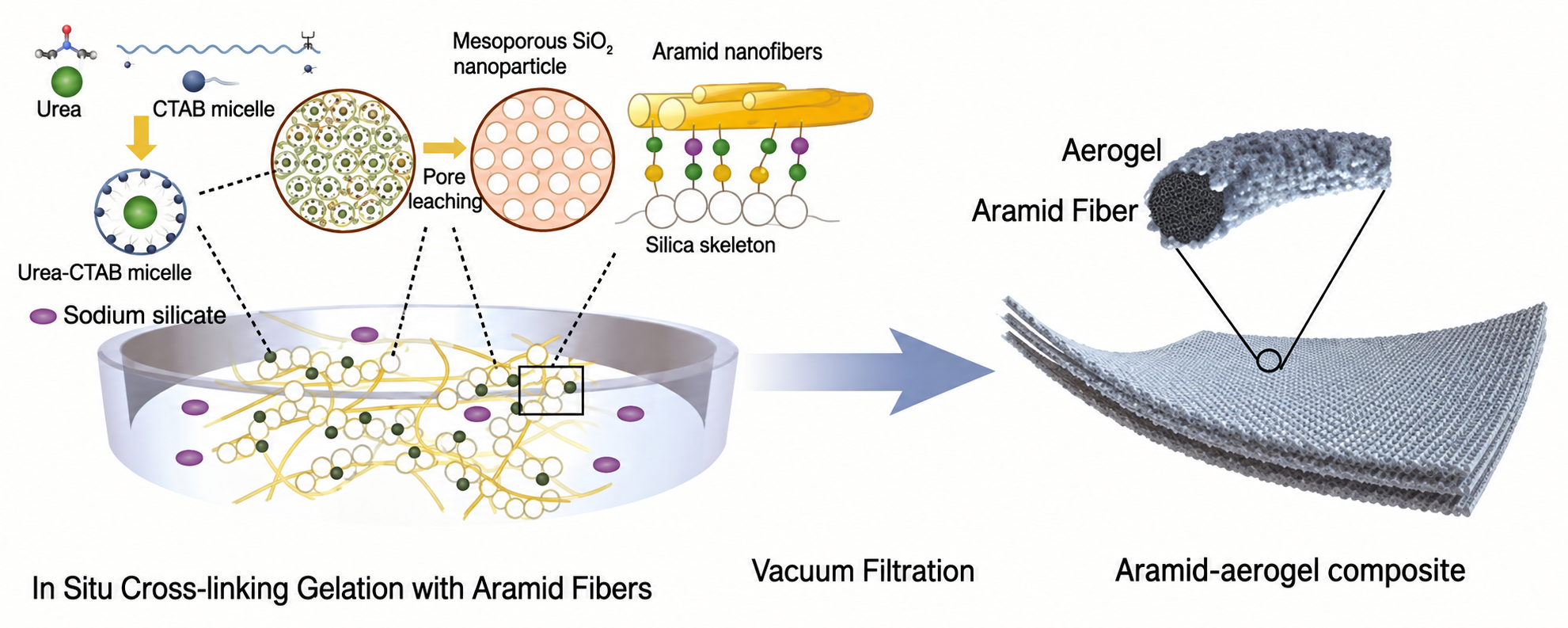
The key to this fabrication method is the in-situ cross-linking that occurs between the silica aerogel precursors and the aramid fibers. During the ambient-pressure drying process, the precursors transform into nanoporous silica aerogel and deposit onto the aramid fibers. The aramid fibers form a percolation network, while the silica aerogel cross-links and deposits onto this fiber network. The interfacial bonding between the aramid fibers and the aerogel, established during gelation, further prevents the collapse of the fiber network.
Having successfully demonstrated the superior properties of this nanocomposite insulation material, the team is now investigating specific applications, including thermal insulation and wear-resistant systems, impact-resistant armor, and structural components for thermal-sensitive applications.


