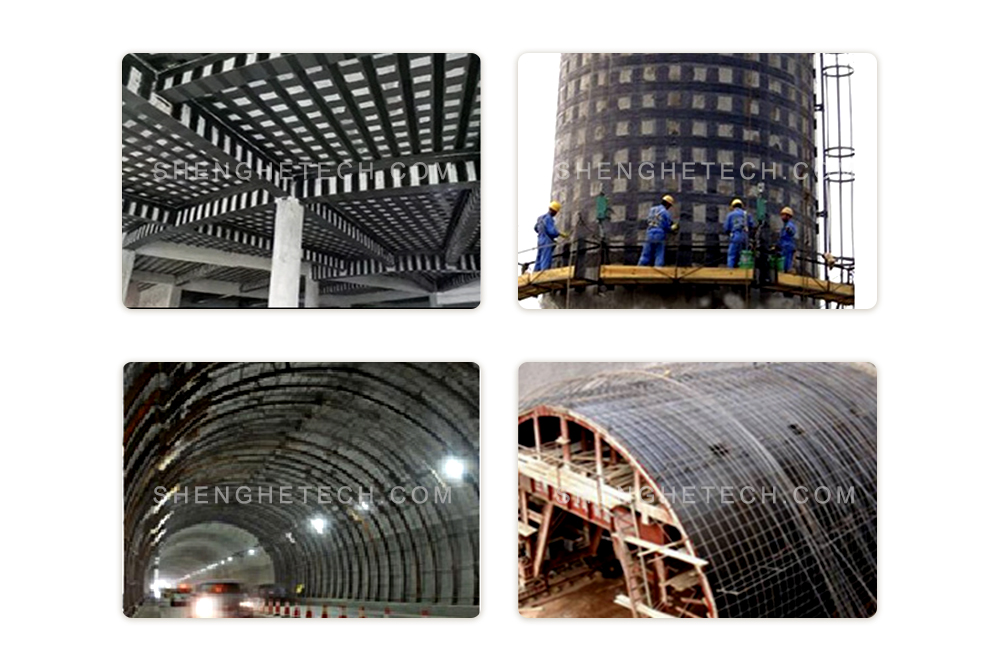
Carbon fiber unidirectional cloth is a cloth made of carbon fiber bundles arranged in one direction. Its manufacturing process involves weaving carbon fiber bundles in one direction to form a thin, strong cloth. The fiber bundles are arranged in a single direction, usually in a parallel pattern, so that there is a lot of flexibility in that direction, high intensity. This structure gives the carbon fiber unidirectional cloth excellent tensile and bending properties in specific directions. It is suitable for building reinforcement, shear, bending and seismic reinforcement of concrete component beams, slabs and columns, and tunnel reinforcement.
Carbon fiber unidirectional cloth is woven from 3K, 6K, 12K, and 24K carbon fibers. Carbon fiber models include T300, T700, T800, M30, M35, M40, T1000, high-strength type, high-strength medium mold, high-strength high modulus, the carbon fiber filaments we use include many well-known domestic brands and well-known imported brands, such as: Janpan's Toray and TEIJIN, mitsubishi chemical, the United States'Hexcel and
ZOLTEK, South Korea's HYOSUNG, Turkey's AKSACA, Belgium's CYTEC SOLVAY GROUP, Germany's SGL.
Carbon fiber unidirectional cloth is a kind of cloth woven from carbon fiber, which is lightweight, high strength and excellent corrosion resistance. It has wide applications in many fields, some of the major applications include:
Aerospace Industry: Carbon fiber unidirectional fabric is widely used in structural components of aircraft, spacecraft and satellites to increase strength and reduce weight. This helps improve the aircraft's fuel efficiency and performance.
Automobile industry: In automobile manufacturing, carbon fiber unidirectional cloth is often used to make lightweight parts such as body structures, doors and interior trims. This helps improve fuel efficiency, enhance vehicle performance and reduce emissions.
Sporting goods: Many sports equipment, such as golf clubs, bicycle frames, skateboards and tennis rackets, are manufactured with carbon fiber unidirectional cloth to reduce weight while maintaining strength.
Construction industry: In building structures, carbon fiber unidirectional cloth can be used to reinforce concrete, steel structures and bridges to improve their seismic performance and load-bearing capacity. For example: it is used for bending and shear reinforcement of concrete structures. It is also widely used for earthquake-proof, anti-cracking and anti-corrosion reinforcement of various industrial and civil buildings and structures. Reinforcement of beams, columns and panels of concrete structures, bridges and buildings. Reinforcement of tunnels, harbor facilities, chimneys, warehouses and factories. Protection and reinforcement of salt-damaged concrete, bridges and river structures.
Shipbuilding: In the field of ships, carbon fiber unidirectional cloth can be used to create lightweight and strong hull structures, improving the speed and fuel efficiency of ships.
Sporting Goods: Some sporting goods, such as skis, tennis rackets, golf clubs, etc., use carbon fiber unidirectional cloth to provide better performance and durability.
Energy industry: In the energy field, carbon fiber unidirectional cloth can be used to manufacture wind power blades and other high-strength, lightweight energy equipment components. Overall, carbon fiber unidirectional cloth has a wide range of applications, mainly due to its excellent strength and lightweight properties, making it one of the ideal materials in many industrial fields.