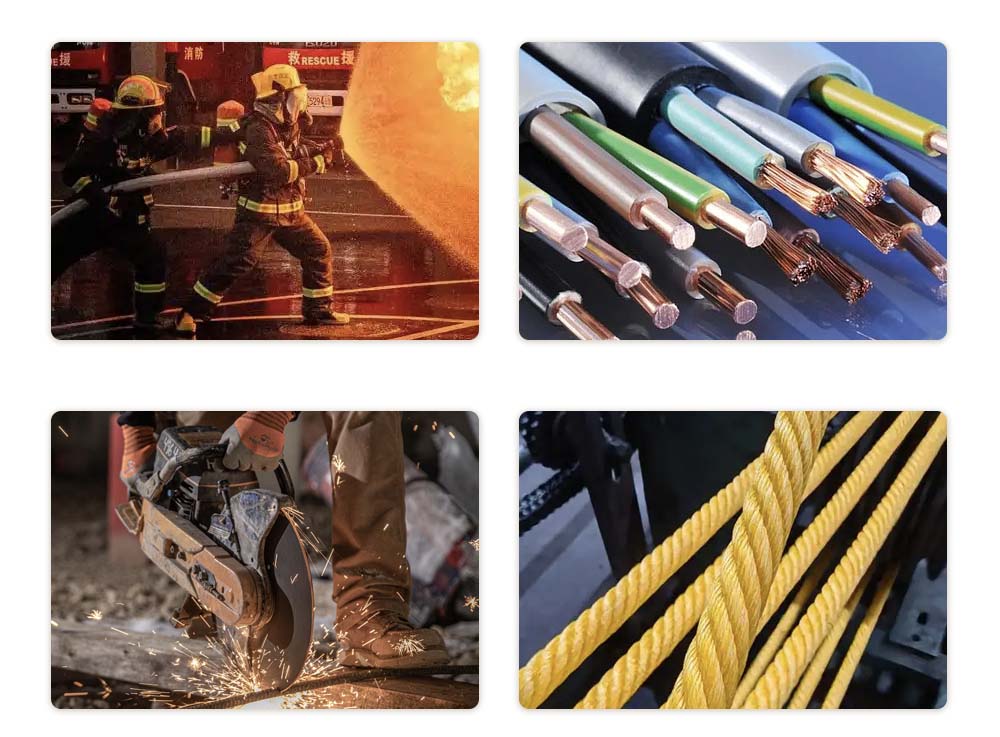
60% Para-Aramid + 40% PBO Blended Fabric
High-performance blended textile combining para aramid fabric durability with PBO fabric thermal and mechanical performance.
Para-Aramid (PPTA, Kevlar-type fiber)
- Para aramid fabric is known for high strength and modulus.
- Excellent heat resistance (continuous use at ~200 ℃).
- Outstanding cut and impact resistance; widely used in protective textiles.
- Flame retardant (LOI ~29–30) and excellent chemical stability.
PBO (Poly(p-phenylene benzobisoxazole), Zylon-type fiber)
- PBO fabric is an ultra-high-performance “super fiber” with tensile strength and modulus significantly higher than aramid.
- Thermal decomposition temperature > 600 ℃; exceptional abrasion and cut resistance.
- Superior energy absorption under impact and outstanding flame retardancy (LOI ~68).
Blending Advantages (60% PPTA + 40% PBO)
- Balances cost-effectiveness of para aramid fabric with the extreme performance of PBO fabric.
- Improved flame resistance, thermal stability, cut resistance, and abrasion performance versus pure aramid.
- More affordable and versatile than pure PBO fabric for sale — attractive in the cut resistant fabrics market.
Manufacturing Process
Fiber Preparation
High-performance para-aramid and PBO fibers (filament or staple) are opened, blended and evenly mixed to maintain consistent distribution across the yarn.
Spinning
Use ring spinning or air-jet spinning while holding the 60:40 ratio to produce yarns with uniform strength and durability suitable for cut resistant fabric applications.
Weaving / Knitting
Typical structures include plain, twill, or satin. High-density plain or twill weaves are preferred for superior abrasion and cut-resistance. The fabric can be woven or knitted depending on the final use case.
Finishing
- Heat-setting for dimensional stability.
- In many cases, additional flame-retardant finishing is not required due to inherent FR properties.
- Optional surface coatings (PTFE, silicone, PU) provide water resistance, chemical protection, or extended durability for harsh environments.
Technical Parameters (Typical Values)
- Fabric Weight (GSM): 160–350 g/m² (customizable)
- Tensile Strength: ≥ 2.5 GPa (depends on yarn and weave)
- Modulus: 80–120 GPa
- Thermal Resistance: Continuous use 250–300 ℃; Peak exposure ≥ 500 ℃
- Flame Retardancy: LOI ≥ 35 (higher than pure aramid)
- Abrasion Resistance: 20–30% better than pure para-aramid fabric
- Dimensional Stability: Heat shrinkage ≤ 2% (at 250 ℃)
- Cut Resistance Level: ANSI/ISEA 105 A6–A9 (structure dependent) — a top-tier cut resistant fabric for sale candidate
Application Fields
(1) Personal Protective Equipment (PPE)
- Firefighter turnout gear and protective hoods
- Cut resistant fabrics for gloves and industrial clothing
- Ballistic vest inner layers and tactical armor
- Pilot suits and motorsport protective suits
(2) Industrial Protection
- Heat-resistant and high-temperature workwear
- Arc flash protective clothing
- Oil & gas chemical protective apparel
- Heavy-duty cut and abrasion-resistant gloves and sleeves
(3) Aerospace
- Aircraft shielding and protective covers
- Spacesuit liners
- Thermal insulation and flame-retardant barriers inside aircraft
(4) Military & Defense
- Ballistic vests, blast blankets, and protective shields
- Composite armor reinforcement layers
- High-strength ropes, cables, and webbings