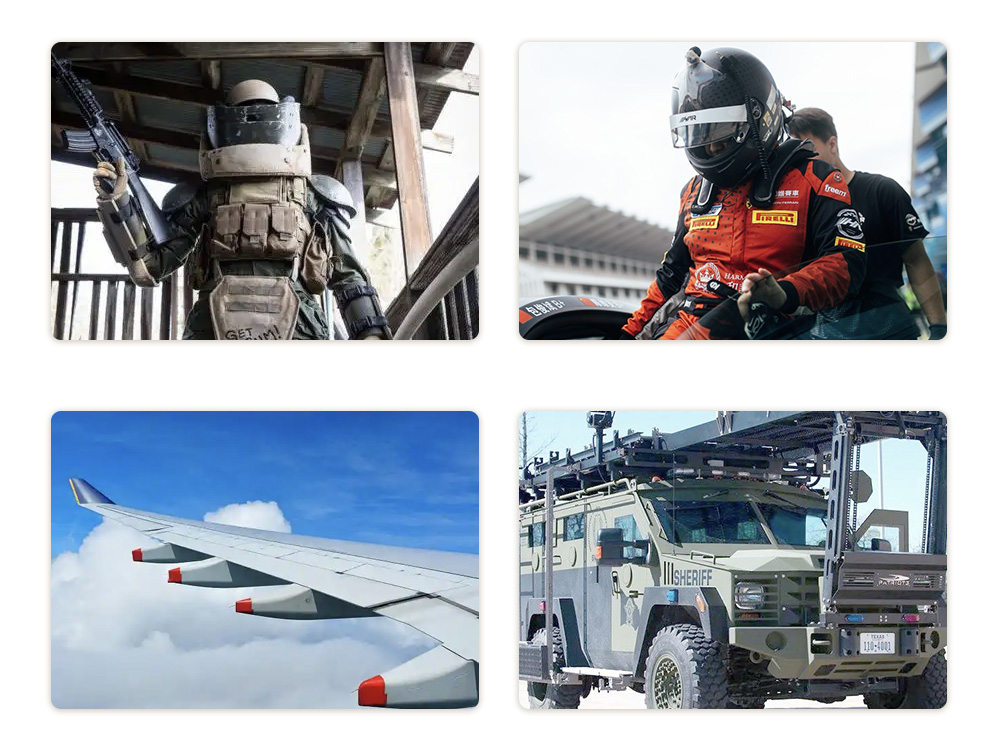
Aramid bulletproof vest hard plate is a bulletproof material made by compounding high-performance aramid fibers (such as para-aramid Kevlar® or meta-aramid Nomex®) with special processes. It is mainly used in the manufacture of bulletproof vests, bulletproof helmets, armored plates and other military and police protective equipment, featuring lightweight, high strength, high temperature resistance and impact resistance.
Aramid Bulletproof Vest Plate Manufacturing Process
1. Raw Material Selection
Aramid Fibers: Usually select para-aramid (such as DuPont Kevlar® K29, with a tensile strength of ≥28 GPa and a modulus of ≥130 GPa) or meta-aramid (such as Nomex®, with a heat resistance of up to 200°C).
Resin Matrix: Epoxy resin, polyamide thermoplastic resin, etc., are used to enhance the bonding force between fibers.
2. Weaving and Laminating
Weaving Process: Adopt a shallow cross-linked 2.5D weaving structure. The warp and weft yarns are cross-linked in a bent or straight state to form a three-dimensional structure, improving impact resistance.
Laminating Molding: Through a hot-pressing process (temperature of 100 - 130°C, pressure of 10 - 20 MPa, and insulation for 30 minutes), the aramid fiber cloth is compounded with resin to form a high-density plate.
3. Post-treatment
Surface Coating: Apply flame retardants or wear-resistant coatings to enhance chemical corrosion resistance and anti-aging properties.
Cutting and Assembly: Cut into specific sizes according to requirements, and compound with bulletproof steel plates, ceramic interlayers, etc., to form a multi-layer protective structure.
Para Aramid Bulletproof Vest Plate Technical Parameters
| Parameter Category |
Value |
| Areal Density |
6 - 20 kg/m² |
| Thickness |
3 - 8 mm |
| Tensile Strength |
≥28 GPa |
| Modulus |
130 - 160 GPa |
| Temperature Resistance |
-196°C to 204°C (long-term use) |
Para Aramid Bulletproof Vest Plate Core Performance
1.Bulletproof Performance
Through the strain fracture and energy absorption mechanism of multiple layers of aramid fibers, it can resist impacts from handguns, fragments, etc., and the protection level can reach Level 3 or above according to the GA141-2010 standard.
After being compounded with ceramics or metals, it can form a "soft-hard combined" protection system. For example, a "steel-aramid-steel" composite armored plate can resist the impact of anti-tank missiles.
2. Mechanical Properties
High specific strength (the strength-to-density ratio is 5 - 6 times that of steel wire) and high modulus (stiffer than glass fiber).
The impact resistance is 5 times that of carbon fiber composites, suitable for dynamic protection scenarios.
3. Environmental Adaptability
Resistant to acids, alkalis, and solvents, and can be used for a long time in harsh environments such as humidity and salt spray.
Low moisture absorption rate (the moisture absorption rate of meta-aramid is <5%), avoiding performance degradation due to water absorption.
4. Lightweight Advantage
The density is only 1.42 - 1.44 g/cm³, which is more than 50% lighter than metal armor, improving the mobility of individual soldiers.
Para Aramid Bulletproof Vest Plate Application Fields
1. Military and Police Protective Equipment
Bulletproof Vests/Helmets: Used as soft bulletproof layers or hard inserts in individual soldier protection.
Anti-riot Equipment: Manufacture anti-riot shields, armored vehicle protective layers for anti-riot vehicles, etc.
2. Aerospace
Aircraft fuselage, wing skins, missile engine casings, meeting the requirements of lightweight and impact resistance.
3. Industrial and Construction
Corrosion-resistant linings for chemical equipment, reinforcement materials for bridges.
4. Civilian Fields
High-end sports protective gear (such as racing suits, mountaineering equipment), explosion-proof toolboxes, etc.
Technical Development Trends
Material Modification: Improve the surface activity of fibers through plasma etching and chemical grafting to enhance the interfacial bonding force with resin.
Composite Structure Innovation: Develop multi-layer composite armors such as "aramid-ceramic-metal" to balance lightweight and protection performance.
Intelligent Integration: Embed sensors to monitor the damage status and realize self-repair functions.
Aramid bulletproof vest hard plates have become the core material of modern protective equipment due to their excellent mechanical properties and environmental adaptability. In the future, through process optimization and composite technology innovation, their application potential in high-end military, industrial, and civilian fields will be further expanded.