PBO Unidirectional Prepreg | PBO Fabric | Heat Resistant Fabrics
100GSM PBO Unidirectional Prepreg is an intermediate composite product made by impregnating PBO fiber with a specific resin system. The term “100GSM” refers to the areal density of the fibers, which balances mechanical properties with processability. This makes it suitable for applications requiring strict weight and performance control.
PBO fiber (also known as Zylon PBO fiber, a type of high-performance pbo fabric), owing to its highly rigid and oriented molecular structure, is hailed as the “super fiber of the 21st century.” It is a benchmark among heat resistant fabrics and possesses the following outstanding characteristics:
- Superior mechanical performance: Tensile strength up to 5.8 GPa and modulus up to 280 GPa. Its specific strength and modulus exceed that of steel wire.
- Excellent heat resistance: Thermal decomposition starts at 650°C, with continuous service temperatures up to 330°C.
- Outstanding flame retardancy: With a limiting oxygen index (LOI) of 68%, it does not burn or melt in flame.
- High chemical stability: Resistant to organic solvents, alkalis, and bleaching agents, but dissolves in strong acids such as concentrated sulfuric acid.
Comparative Performance of High-Performance Fibers
| Property |
PBO Fiber |
Para-aramid |
High-Modulus Carbon Fiber |
UHMWPE |
| Tensile Strength (GPa) |
5.8 |
2.9–3.4 |
3.5–7.0 |
2.5–3.5 |
| Tensile Modulus (GPa) |
280 |
64–144 |
200–400 |
100–200 |
| Decomposition Temp (°C) |
650 |
500–550 |
600–700 (in air) |
140–150 (melting point) |
| LOI (%) |
68 |
29 |
– |
16–18 |
| Density (g/cm³) |
1.56 |
1.44 |
1.75–2.00 |
0.97 |
Despite its advantages, PBO fiber has relatively low axial compressive strength (0.2–0.4 GPa) and an inert surface that bonds poorly with resin matrices. Surface treatment is therefore essential. In addition, pbo zylon fiber has poor UV resistance, requiring protective measures for outdoor applications.
Manufacturing Process and Technology
Surface Modification Treatments
Since pbo fiber fabric has low surface activity and poor adhesion to resins, surface treatments are required:
- Chemical etching: Using polyphosphoric acid (PPA) or acid solutions to slightly etch the fiber surface, increasing roughness.
- Plasma treatment: Low-temperature plasma introduces active groups, enhancing surface energy.
- Enzymatic treatment: Using horseradish peroxidase and similar enzymes to generate radicals and initiate grafting reactions.
- Coupling agent coating: Applying silane coupling agents (e.g., KH-560) to strengthen chemical bonding with resins.
An optimized combined treatment process is: gamma irradiation → PPA etching → silane coupling agent YDH560 coating. This increases interlaminar shear strength by 26% and compressive strength by 17%.
Prepreg Manufacturing Processes
- Solution impregnation: Resin is dissolved in solvent to form a gel solution. Unidirectional prepreg fibers are passed through the resin bath, then dried to remove solvent. This method requires strict control of volatiles (typically 3 ± 0.5%) and resin insoluble content (≤10%).
- Hot-melt impregnation: Resin is first made into a thin film, then combined with unidirection prepreg fibers under heat and pressure. This solvent-free process is environmentally friendly and ensures precise resin content, ideal for high-performance applications.
Key Technologies for Ultra-Thin Prepregs (100GSM)
- Fiber spreading & ultra-thin alignment: Ensures ordered filament arrangement and minimizes damage.
- Precision tension control: Prevents fiber breakage or slack.
- Airflow-guided resin distribution: Ensures uniform resin dispersion.
Technical Parameters and Performance
Physical Parameters
- Areal fiber weight: 100 ± 5 g/m²
- Resin content: 35 ± 3%
- Single-layer thickness: 0.08–0.12 mm
- Width: typically 300–600 mm (customizable)
- Volatile content: <0.5% (hot-melt), <1.5% (solution method)
Mechanical Properties (after curing)
- Tensile strength: ≥2,500 MPa
- Tensile modulus: ≥180 GPa
- Flexural strength: ≥1,500 MPa
- Interlaminar shear strength (ILSS): ≥40 MPa (≥43 MPa with surface treatment)
- Compressive strength: ≥160 MPa (≥168 MPa with surface treatment)
Processing Properties
- Gel time (depending on resin system): 15–30 min at 125°C
- Tack life (at room temperature): 30–45 days
- Curing conditions: 120–180°C, 0.5–1.5 MPa
Applications of PBO Unidirectional Prepreg
Aerospace
- Aircraft black box casings: Exploiting PBO’s flame resistance, impact resistance, and seawater durability (survives 3 months without corrosion).
- Spacecraft structures: Rocket engine insulation layers, fuel tanks, etc.
- UAV components: Wings and fuselage load-bearing parts for lightweight, high-strength designs.
Protection & Armor Systems
- Ballistic protection: Bulletproof vests and helmets with superior energy absorption compared to carbon fiber and aramid.
- Vehicle armor: Lightweight protective components for armored vehicles.
Advanced Industry & Sports Equipment
- High-temperature filtration: Used in metallurgy, cement, and other industries for filter bags/felts.
- High-performance sports gear: Sailing ropes, racing sails, premium bicycle frames, etc.
- Optical cable reinforcements: Strength members and protective materials.
New Energy & Transportation
- Fuel cell pressure vessels: PBO fiber-wound tanks for hydrogen storage.
- High-speed trains: Load-bearing components such as noses, car bodies, and steering wheels for weight reduction.
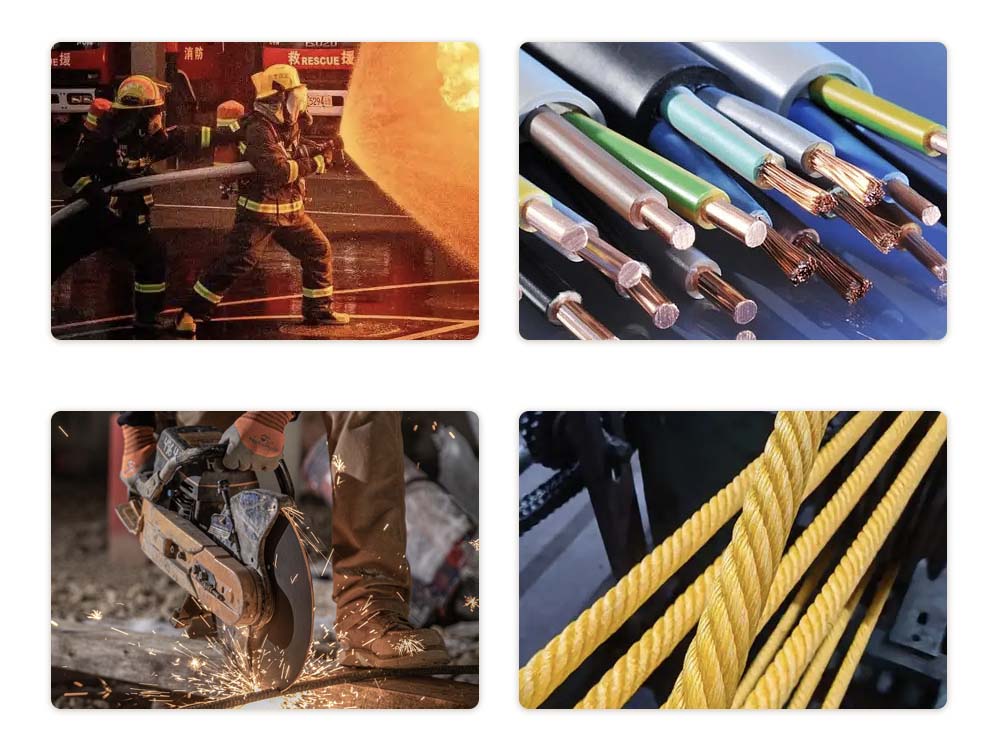
Advantages and Limitations
Advantages
- Lightweight & high strength: Specific strength exceeds steel wire, enabling 20–30% structural weight reduction.
- High temperature resistance: Operating temperature ~100°C higher than aramid.
- Excellent impact resistance: Energy absorption 4× that of carbon fiber composites.
- High electromagnetic transparency: Over 98% transmission, suitable for stealth and radome structures.
Limitations & Countermeasures
- Poor interfacial bonding: Requires advanced surface treatments.
- Poor UV resistance: Needs protective coatings or UV absorbers.
- High cost: Much more expensive than carbon fiber and aramid, limiting mass applications.
- Relatively low compressive strength: Can be improved via fiber modification and composite design optimization.
Understanding PBO Fiber and Unidirectional Prepreg
- What is PBO fiber? It stands for poly(p-phenylene-2,6-benzobisoxazole), known commercially as Zylon.
- What does PBO fiber stand for? PBO = Polybenzoxazole.
- Zylon PBO fiber properties: exceptional tensile strength, modulus, heat resistance, and flame retardancy.
- What does unidirectional mean? Fibers are aligned in a single direction, optimizing strength along one axis.
- Unidirection prepreg tape composite machine supplier in China: Key equipment manufacturers enable precise fiber alignment and resin impregnation for consistent prepreg quality.
- PBO fiber market: Driven by aerospace, defense, new energy, and high-performance sports equipment sectors.
- Pro fabric for sale: As a premium pbo fabric solution, prepreg products are increasingly offered by specialized suppliers.
Conclusion
100GSM PBO Unidirectional Prepreg represents the cutting edge of heat resistant fabrics and pbo fiber fabric technology. With ongoing breakthroughs in domestic industrialization and growing pbo fiber market demand, this material is expected to play an increasingly critical role in aerospace, defense, transportation, and other advanced fields.


