Carbon fiber prepreg unidirectional cloth is a composite semi-finished product made by arranging carbon fiber in a single direction and uniformly coating its surface with a pre-formulated resin (usually epoxy resin, phenolic resin or polyimide resin), and then hot pressing or heating the surface by controlling the process parameters.
Preparation process of carbon fiber unidirectional prepreg cloth
The preparation process of carbon fiber unidirectional prepreg cloth mainly includes raw material preparation, pre-impregnation, drying, cutting and other links. High-quality carbon fiber and suitable resin are selected as raw materials, and the resin is fully impregnated on the carbon fiber after pretreatment and impregnation process. Then, after drying treatment, the resin in the prepreg cloth is solidified, and finally the prepreg cloth that meets the requirements is obtained through the cutting process.
Characteristics of carbon fiber unidirectional prepreg cloth
Carbon fiber unidirectional prepreg cloth has high longitudinal tensile strength and modulus, which can effectively enhance the strength and stiffness of the product. Carbon fiber has excellent corrosion resistance and impact resistance, which can effectively extend the service life of the product. Due to the lightweight characteristics of carbon fiber, the overall weight of the product can be effectively reduced to meet today's lightweight design needs.
1.Lightweight and high strength: It has an extremely high strength-to-weight ratio, which is several times that of steel, and its density is much lower than that of metal materials.
2.Excellent mechanical properties: Unidirectional cloth can achieve directional reinforcement, and its tensile strength and modulus are optimal along the fiber direction.
3.Good corrosion resistance: It has strong resistance to chemical corrosion and is suitable for harsh environments.
4.Thermal stability: It has excellent high temperature resistance and extremely low thermal expansion coefficient, which is suitable for high-precision demand scenarios.
5.Strong process adaptability: It can be used for a variety of processes such as hand lay-up molding, automatic laying molding and winding molding.
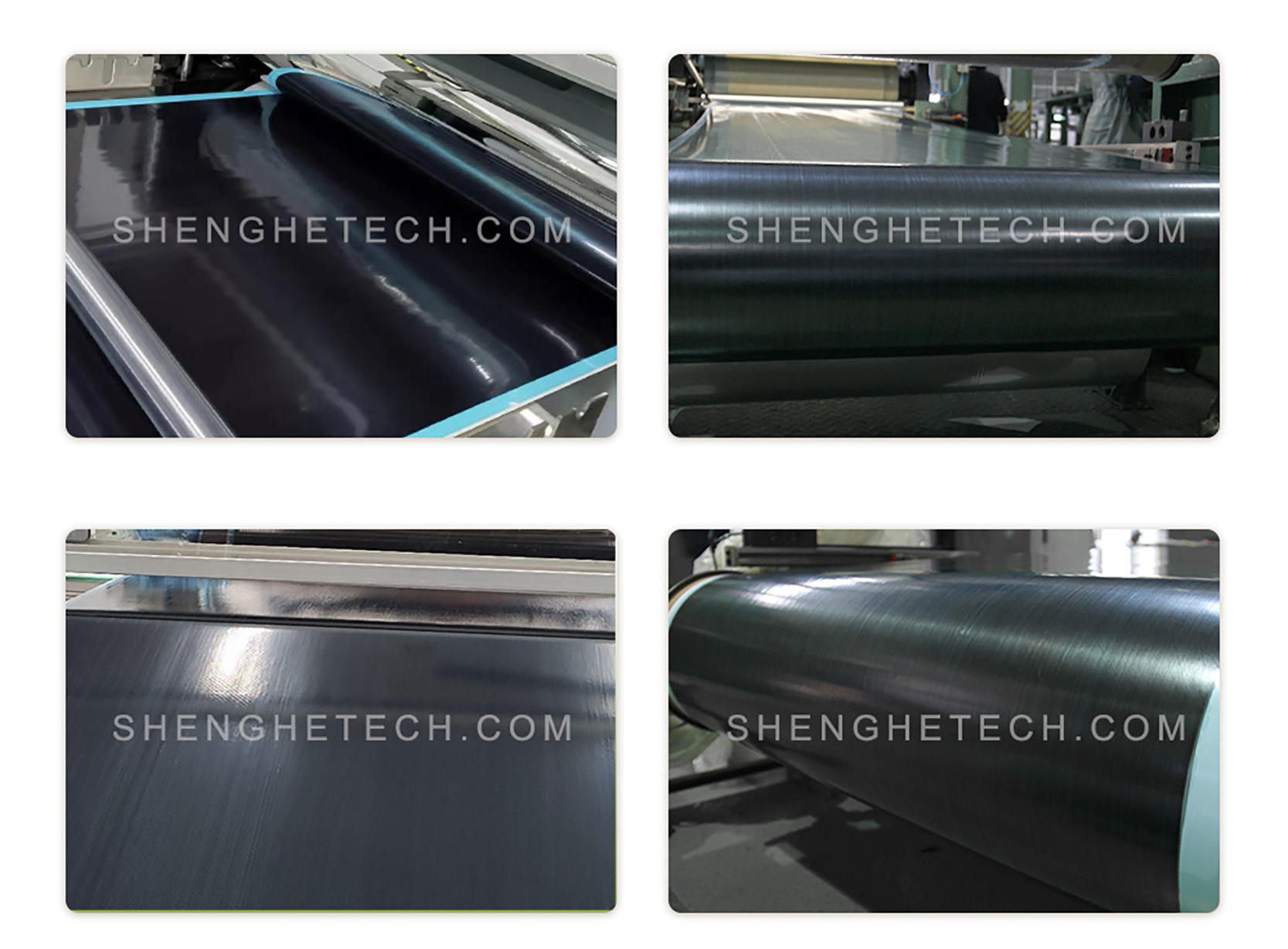
Composition structure
Carbon fiber: As a reinforcing material, it is usually high-strength and high-modulus carbon fiber, and typical specifications include T300, T700, T800, etc.
Resin matrix: Commonly used resins include epoxy resin (high strength and good toughness), phenolic resin (high temperature resistance and strong flame retardancy) and unsaturated polyester resin (low cost and fast curing speed). Other ingredients: May include curing agents, diluents, etc. to optimize the performance and processing technology of the resin system.
Manufacturing process
Fiber arrangement: The carbon fiber bundles are neatly arranged into a unidirectional structure through a guide device.
Resin coating: The resin is evenly coated on the surface of the carbon fiber to ensure that the resin fully penetrates into the fiber.
Heat treatment: The resin is initially cured by heating and rolling, while maintaining the flexibility of the sheet for subsequent processing.
Cutting and packaging: Cut into rolls or sheets according to user needs, and seal the packaging to avoid premature curing of the resin.
| Type |
Dry Weight (g/m²) |
Resin Content (%) |
Total weight (g/m²) |
Thickness (mm) |
Width (mm) |
|
| SH-CF3000 |
30 |
55 |
76 |
0.03 |
1000 |
| SH-CF5000 |
50 |
45 |
91 |
0.06 |
1000 |
| SH-CF7500 |
75 |
38 |
121 |
0.088 |
1000 |
| SH-CF10000 |
100 |
33 |
150 |
0.10 |
1000 |
| SH-CF12500 |
125 |
33 |
187 |
0.13 |
1000 |
| SH-CF15000 |
150 |
33 |
224 |
0.15 |
1000 |
| SH-CF17500 |
175 |
33 |
261 |
0.18 |
1000 |
| SH-CF20000 |
200 |
33 |
298 |
0.20 |
1000 |
SH-CF22500
|
225 |
33 |
337 |
0.23 |
1000 |
SH-CF25000
|
250 |
33 |
374 |
0.25 |
1000 |
Application areas
- Aerospace: Manufacturing aircraft wings, tails, structural frames, etc.
- Automobile manufacturing: Used for lightweight parts such as body structural parts and drive shafts.
- Wind power generation: Reinforcement materials for wind turbine blades, significantly improving strength and fatigue resistance.
- Sports goods: high-end bicycle frames, tennis rackets, golf clubs, etc.
- Construction engineering: Used in bridge reinforcement, earthquake repair and other fields.