Carbon fiber prepreg is a composite material made of reinforcing materials (carbon fiber yarn, epoxy resin, release paper) through coating, hot pressing, cooling, laminating, winding and other processes. Carbon fiber prepreg is a high-performance composite material, widely used in high-tech fields such as aerospace, automobiles, wind energy and sports equipment.
Composition structure
Reinforcement material: carbon fiber
High strength and high modulus: Carbon fiber has very high tensile strength and rigidity, usually 5-10 times stronger than steel, but much lighter.
Excellent heat resistance: It can maintain stable performance under high temperature environment.
Corrosion resistance: It is not easily corroded by chemicals. Corrosion resistance: It is not easily corroded by chemicals.
Matrix material: resin
Thermosetting resin: For example, epoxy resin has good heat resistance and adhesion.
Thermoplastic resin: Such as PEEK or PPS, which has higher processing flexibility and impact resistance.
| Type |
Yarn |
Weave |
Dry Weight (g/m²) |
Resin Content (%) |
Total weight (g/m²) |
Thickness (mm) |
Width (mm) |
| Warp |
Weft |
| SH-CF1120 |
1K |
1K |
Plain |
120 |
40 |
205 |
0.16 |
1000 |
| SH-CF1120 |
1K |
1K |
Twill |
120 |
40 |
205 |
0.16 |
1000 |
| SH-CF3200 |
3K |
3K |
Plain |
200 |
40 |
330 |
0.28 |
1000 |
| SH-CF3200 |
3K |
3K |
Twill |
200 |
40 |
330 |
0.28 |
1000 |
| SH-CF3240 |
3K |
3K |
Stain |
240 |
40 |
405 |
0.30 |
1000 |
| SH-CF6320 |
6K |
6K |
Plain |
320 |
40 |
530 |
0.40 |
1000 |
| SH-CF6320 |
6K |
6K |
Twill |
320 |
40 |
530 |
0.40 |
1000 |
| SH-CF6400 |
6K |
6K |
Stain |
400 |
40 |
665 |
0.40 |
1000 |
SH-CF12400
|
12K |
12K |
Plain |
400 |
40 |
670 |
0.50 |
1000 |
SH-CF12800
|
12K |
12K |
Twill |
480 |
40 |
800 |
0.55 |
1000 |
Manufacturing process
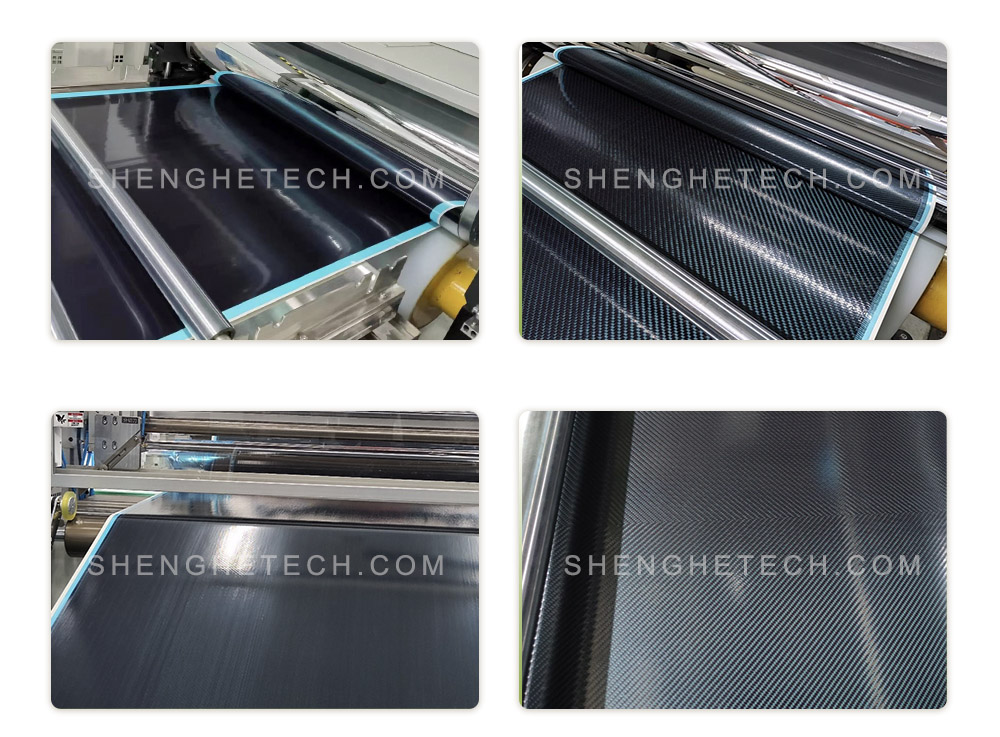
Fiber laying: Arrange carbon fibers in a certain direction (unidirectional cloth) or interweave into fabrics (plain, twill, satin, etc.).
Coating resin: Evenly apply an appropriate amount of resin matrix on the surface of carbon fiber fabric.
Control the amount of glue: strictly control the resin content through hot pressing or coating equipment, generally between 30%-50%.
Semi-curing treatment: the prepreg cloth is heat-treated before the resin is cured to form a "B-stage" (semi-cured state) to facilitate subsequent molding.
Main classification
According to carbon fiber raw yarn:
1. PAN-based carbon fiber cloth (more than 90% of the carbon fiber cloth on the market is this type of carbon fiber cloth).
2. Viscose-based carbon fiber cloth.
3. Asphalt-based carbon fiber cloth.
According to carbon fiber specifications:
1K carbon fiber cloth.
3K carbon fiber cloth.
6K carbon fiber cloth.
12K carbon fiber cloth.
24K and above large tow carbon fiber cloth.
According to carbonization of carbon fiber:
1. Graphitized carbon fiber cloth, which can withstand high temperatures of 2000-3000 degrees.
2. Carbon fiber cloth, which can withstand high temperatures of about 1000 degrees.
3. Pre-oxidized carbon fiber cloth, which can withstand high temperatures of 200-300 degrees.
According to weaving methods:
1. Dry prepreg.
2. Wet prepreg.
3. Unidirectional prepreg.
4. Prepreg tape.
5. No support cloth.
6. With support cloth, etc.
Performance characteristics
Lightweight: The density is only 1/5 of steel, suitable for weight-sensitive application scenarios.
High strength and rigidity: excellent in load bearing capacity.
Excellent fatigue resistance: able to withstand long-term repeated loads without failure.
Good formability: can be formed into various complex structures in the mold.
Low thermal expansion coefficient: stable performance in extreme temperature difference environments
Application areas
1. Aerospace: fuselage, rudder, rocket engine shell, missile diffuser, solar panels, etc.
2. Sports equipment: lightweight and durable products such as auto parts, motorcycle parts, fishing rods, baseball bats, skis, speedboats, badminton rackets, high-end bicycle racks, tennis rackets, skis, etc.
3. Industry: engine parts, concrete structure reinforcement materials, fan blades, transmission shafts, and electrical components.
4. Firefighting: suitable for the production of special fire-resistant clothing for troops, firefighting, steel mills, etc.