Explore polyimide materials, including synthesis methods, thermal stability, dielectric properties, and applications in electronics and aerospace.
Polyimide: Innovative Breakthroughs and Future Prospects for High-Performance Polymer Materials
As a class of high-performance polymer materials characterized by exceptional thermal stability, chemical inertness, and mechanical strength,
polyimides play an irreplaceable role in fields such as electronic devices, aerospace, optoelectronics, and new energy. In recent years, innovations in molecular structure design and the optimization of synthesis methods have led to significant advancements in the transparency, solubility, dielectric properties, and processability of polyimides. These developments provide critical material support for cutting-edge technologies such as flexible electronics, 5G communications, and transparent displays. This article systematically reviews the latest research progress on polyimides, focusing on innovations in synthesis methods, strategies for performance optimization, and prospects for practical application.
Innovations in Synthesis Methods and Process Optimization
Traditional synthesis methods for
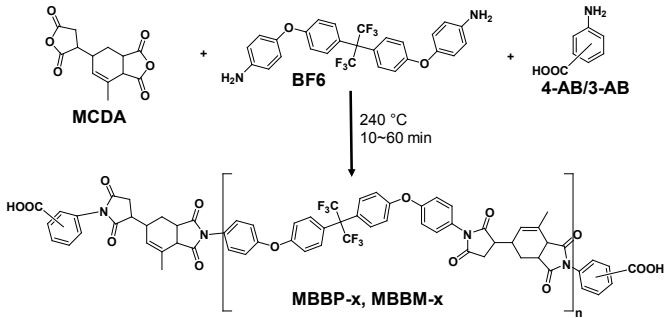
polyimides primarily involve melt polymerization and solution polymerization. Melt polymerization—which involves the rapid reaction of dianhydride, diamine, and monoamine monomers at high temperatures (e.g., 240°C)—enables the production of polyimides with controllable molecular weights in a short timeframe. Research indicates that the MBBP and MBBM series of polyimides, synthesized using BF6 as the diamine monomer, achieve high solubility (up to 30 wt%) in the eco-friendly solvent PGMEA while maintaining excellent thermal stability; this significantly enhances the material's processability and ease of use.
Solution polymerization simplifies the synthesis process through a one-pot method, thereby significantly improving reaction efficiency. This approach imparts photocuring capabilities to the polyimide by introducing photosensitive groups, such as methacrylates, at the polymer chain ends. Upon UV irradiation, the double bonds at these end groups undergo cross-linking to form a three-dimensional network structure, substantially boosting the material's thermal stability. Experimental data show that UV-cured polyimides exhibit higher thermal decomposition temperatures in thermogravimetric analysis, with the temperature at 1% weight loss exceeding 345°C.
Microwave-assisted synthesis technology has brought about a revolutionary breakthrough in the preparation of polyimides. Compared to traditional heating methods, microwave radiation enables rapid, uniform heating, significantly shortening reaction times and enhancing product purity. For instance, the synthesis of the BHPMEPM monomer can be completed within 15 minutes with a yield of up to 91%; the resulting product exhibits excellent thermal curing properties, offering a novel approach for the large-scale production of high-performance polyimides.
Synergistic Optimization of Optical and Dielectric Properties
Through ingenious molecular design, researchers have successfully achieved the synergistic optimization of the optical and dielectric properties of
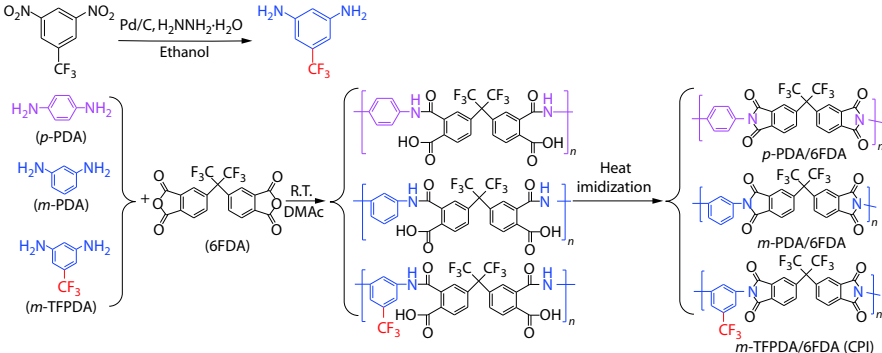
polyimides. Introducing meta-substituted groups and highly electronegative moieties—such as trifluoromethyl groups—into the molecular structure serves as an effective strategy for enhancing optical performance. Polyimide films prepared from m-TFPDA and 6FDA monomers exhibit a cutoff wavelength reduced to 334 nm, a transmittance of 85.26% at 450 nm, and a yellowness index of only 3.96, demonstrating exceptional optical characteristics approaching colorlessness.
The mechanism behind this performance enhancement lies in the fact that the meta-substituted structure and the trifluoromethyl groups effectively inhibit the formation of intra- and intermolecular charge-transfer complexes (CTCs). Density functional theory (DFT) calculations indicate that the energy gap (ΔE) of the meta-substituted trifluoromethyl structure reaches 6.37 eV—significantly higher than that of traditional polyimides (e.g., 5.04 eV for Kapton film). This effectively reduces absorption in the visible light region, thereby increasing the film's transparency.
Regarding dielectric properties, the introduction of bulky substituents increases the spacing between molecular chains, effectively raising the material's free volume fraction. Positron annihilation lifetime spectroscopy reveals that the free volume fraction of the trifluoromethyl-containing polyimide reaches 1.94%, significantly higher than that of traditional polyimides (0.36%). This structural feature allows the polyimide film to maintain excellent mechanical properties while achieving a dielectric constant as low as 2.27 (at 10 kHz) and a dielectric loss as low as 0.0013. Crucially, these excellent dielectric properties remain stable at high temperatures (up to 280°C), while the material's low moisture absorption (approximately 0.51%) ensures reliability in humid environments.
Balancing Comprehensive Properties and Expanding Applications
Performance optimization for
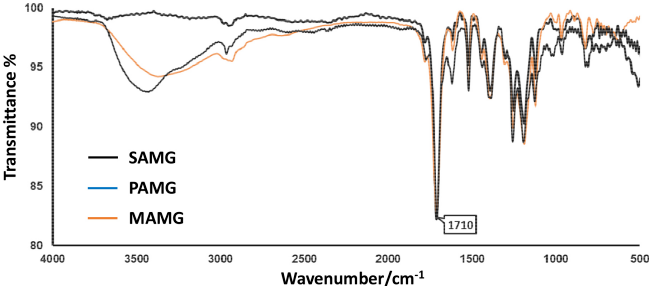
polyimides is not limited to a single characteristic but aims for a balanced enhancement of multiple properties. Regarding thermal performance, the new polyimide exhibits excellent heat resistance, with a glass transition temperature of 296°C and a 5% thermal decomposition temperature reaching 522°C, enabling it to meet the demands of high-temperature manufacturing processes. Simultaneously, the material maintains robust mechanical properties, featuring a tensile strength of 85.1 MPa, a tensile modulus of 1.96 GPa, and an elongation at break exceeding 6%, demonstrating good flexibility and toughness.
In terms of processability, molecular structure optimization allows the new polyimide to maintain high performance while exhibiting good solubility in common organic solvents (such as DMAc, DMF, and NMP). This characteristic enables fabrication via simple solution-based processes (e.g., spin coating and blade coating), facilitating continuous roll-to-roll production and significantly reducing manufacturing costs.
This balance of comprehensive properties positions the polyimide for broad application prospects across various high-tech sectors. In flexible displays, transparent polyimide can serve as a flexible substrate, replacing traditional glass substrates; in integrated circuits, low-dielectric-constant polyimide can be used as an interlayer dielectric material to meet high-frequency signal transmission requirements; and in the new energy sector, its excellent thermal stability and insulation properties make it valuable for battery separators and packaging materials.
Future Trends and Challenges
The rapid advancement of 5G communications, artificial intelligence, and the Internet of Things (IoT) has created a demand for higher-performance polymer materials. Future research on polyimides will focus on multifunctionality and smart capabilities. On one hand, precise control over properties such as the dielectric constant and coefficient of thermal expansion will be achieved through the further optimization of molecular structure design; on the other hand, the development of polyimide materials with smart functionalities—such as self-healing and shape-memory capabilities—will emerge as a key research direction.
At the same time, the drive for green and sustainable development imposes new requirements on polyimide synthesis processes. Developing environmentally friendly synthetic routes, utilizing renewable raw materials, reducing the use of hazardous solvents, and enhancing material recyclability will all become critical topics for future research. Furthermore, as application areas expand, the integration of multiple functions within polyimide materials—such as combining thermal conductivity with electrical insulation, or transparency with electrical conductivity—will attract increasing attention.
Conclusion
As a representative high-performance polymer,
polyimide has seen significant progress in synthesis methods, property tuning, and application expansion through continuous, innovative research. Driven by ongoing innovations in molecular design concepts and the continuous optimization of preparation processes, polyimide is poised to play a pivotal role in an increasing number of high-tech fields, providing a solid material foundation for future technological advancements.


