Aerospace vehicles require that every component be optimized for weight, performance, and functionality.
As the aerospace industry continues its upward recovery, next-generation aircraft designs continue to advance with higher expectations than ever before. New aircraft should be lighter, faster, safer, stronger, and of course, more cost-effective than the ones they are replacing. Macro trends in the aviation industry are driving technological advances in the smallest components of flying machines.
Aerospace vehicles require that every component be optimized for weight, performance, and functionality. Additive manufacturing, or 3D printing, has risen to prominence in the first two areas. With complexity decoupled from manufacturing cost, complex parts can be designed to reduce weight without sacrificing performance, something that traditional manufacturing methods cannot match. Additively manufactured parts have proven performance and are increasingly being used on aerospace platforms, including Boeing’s CST-100 spacecraft. But what role does additive manufacturing play in providing multifunctional part solutions? What can be required of a simple bracket or closed panel beyond the mechanical and environmental performance of existing materials? Can we make parts multifunctional?
Hexcel has brought together its Additive Manufacturing HexAM® team and its Radio Frequency Interference Control product team to investigate versatile 3D printed components that meet aerospace requirements. The result of the collaboration is HexPEKK® EM, which enhances the electromagnetic properties of the proven HexAM® technology. As the newest member of the HexPEKK® material portfolio, HexPEKK® EM provides the ability to additively manufacture versatile production parts that meet both mechanical and electromagnetic performance requirements.
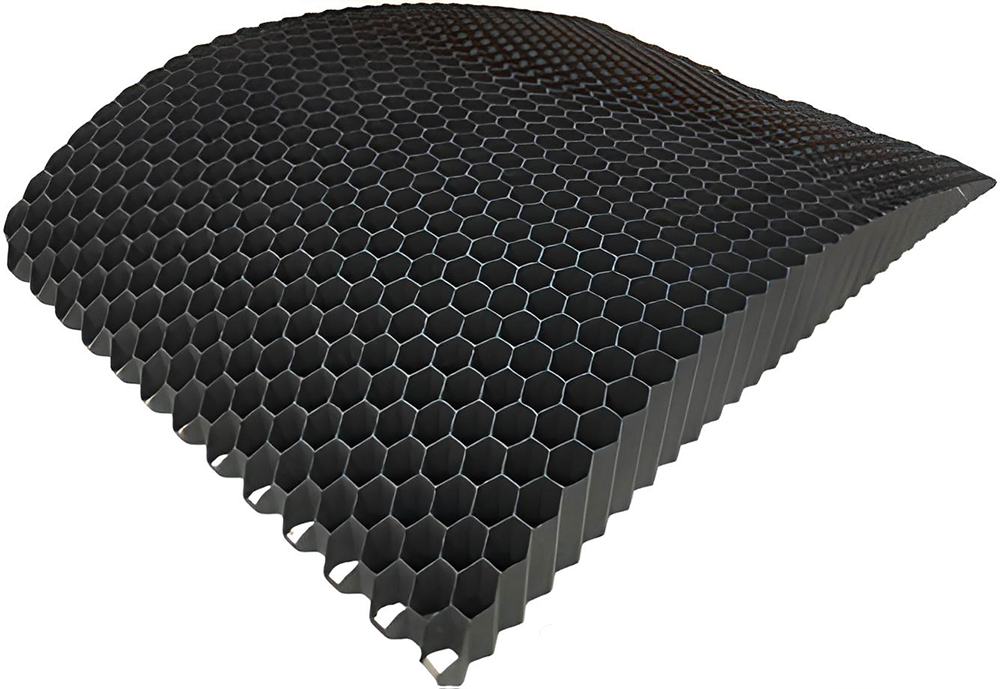
Electromagnetic Interference and RF Absorption
Complex electronic systems in the aerospace and defense industries continue to increase in performance and capabilities while operating in more frequency ranges than ever before. While increased performance benefits the aircraft as a whole, electromagnetic interference (EMI) has become a growing concern. EMI can come from both internal and external sources, and electronic components can cause a significant amount of unwanted interference within an aircraft. EMI poses a risk to the effectiveness of electronic systems, which can lead to various levels of malfunction or failure. As compliance and safety regulations increase, EMI mitigation should be considered at design time. HexPEKK® EM improves the EMI performance of existing HexPEKK® materials. Housings, brackets and panels adjacent to electronic systems manufactured with HexPEKK® EM can be a means to help mitigate EMI while leveraging the design freedom and weight savings that additive manufacturing promotes.
Low Resistivity
The management of static electricity buildup is an important consideration for primary and secondary structures in aviation applications. Low resistivity materials are needed in aircraft components because normal flight operations result in static electricity buildup. Grounding considerations are essential in sensitive electrical equipment areas. When static electricity builds up and is discharged, it can create an electric shock as the current is transmitted, which can be hazardous to the aircraft, causing potential damage to sensors, processors and other components critical to flight operations. Discharge management has been a barrier to the adoption of composites for certain applications. Hexcel’s flagship additive material, HexPEKK®-100, includes carbon in its formulation specifically designed to meet electrostatic discharge (ESD) requirements. Hexcel’s newest material, HexPEKK® EM, goes a step further, with a resistivity more than three orders of magnitude lower than HexPEKK®-100. HexPEKK® EM retains all the benefits of high-performance 3D printed PEKK thermoplastics, making them suitable for many components of aerospace systems.
Next-generation aerospace platforms will require every material and hardware to prove its place on increasingly smaller and lighter platforms. Additive manufacturing technologies that are based on sound structural principles and include multifunctional capabilities will play an increasing role in this design revolution.


