Common forms of carbon fiber woven fabrics include plain carbon cloth, carbon cloth twill, satin carbon cloth, unidirectional carbon cloth, bidirectional carbon cloth, multi-axial carbon cloth, prepreg carbon cloth.
Carbon fiber performance
The density and cost comparison of carbon fiber and other reinforcing fibers is shown in the figure below. The density of carbon fiber is between aramid fiber and glass fiber, and its cost is higher than other traditional reinforcing fibers, especially high modulus carbon fiber has the highest cost.
The mechanical properties comparison of carbon fiber and other reinforcing fibers is shown in the figure below. Carbon fiber has certain advantages over other reinforcing fibers in strength and modulus. However, the production cost of carbon fiber is also much higher than other reinforcing fibers.
What are the fabric forms of fibers?
The mechanical properties comparison of carbon fiber and other reinforcing fibers is shown in the figure below. Carbon fiber has certain advantages over other reinforcing fibers in strength and modulus. However, the production cost of carbon fiber is also much higher than other reinforcing fibers.
According to the carbon fiber weaving method, carbon fiber fabrics can be divided into woven fabrics, knitted fabrics and non-woven fabrics. Among them, woven fabrics can be divided into plain weave, twill and satin according to the warp and weft fiber interlacing rules, as shown in the figure below.
Common forms of carbon fiber woven fabrics
Carbon fiber non-woven fabrics are also called non-woven fabrics. They refer to a type of fabric that has not been woven. As shown in the figure below, the traditional methods for forming textile fiber non-woven fabrics mainly include spunlace, needle punching, hot rolling, etc.
 Carbon fiber non-woven fabrics
What are the main factors affecting the selection of reinforcing materials?
The mechanical properties of carbon fiber and other reinforcing fibers are compared as shown in the figure below. Carbon fiber has certain advantages over other reinforcing fibers in terms of strength and modulus. However, the production cost of carbon fiber is also much higher than that of other reinforcing fibers.
| Reinforcement Materials |
Advantage |
Application |
| Unidirectional |
Unidirectional belt |
Unidirectional strength and stiffness
Wide range of fiber surface density
Minimum: ≈ 100 G/M2
Maximum:
Glass fiber ≈ 3000 G/M2
Carbon fiber ≈ 800 G/M2 |
Sporting goods
Aircraft
Main structure
Wind energy
Load-bearing structure |
| Monofilament |
Suitable for winding process.
Suitable for high-precision paving process. |
Pressure vessel
Drive shaft
Pipeline |
| Narrowband |
Unidirectional high strength and high stiffness.
The fiber surface density for the main structure can be as low as 134G/M2.
Very suitable for efficient laying of complex parts. |
Aerospace primary structures |
| Fabric (radial > 80 %) |
Suitable for parts requiring high unidirectional strength and high stiffness.
Good processing properties.
Fiber surface density ranges from 160 to 1 000 g/m². |
Aerospace
Industry |
| Bidirectional |
Balanced fabric
|
Bidirectional strength and stiffness.
Good handling performance.
Good draping.
Choice of weaving types.
Multiple fiber blends are available.
Fiber surface density 20~1000 g/m².
Carbon fabric, fiber expanded, uniform appearance, suitable for decoration.
|
Aviation and aerospace
Industry
Sports and leisure
Wind energy
|
| Multi-axial |
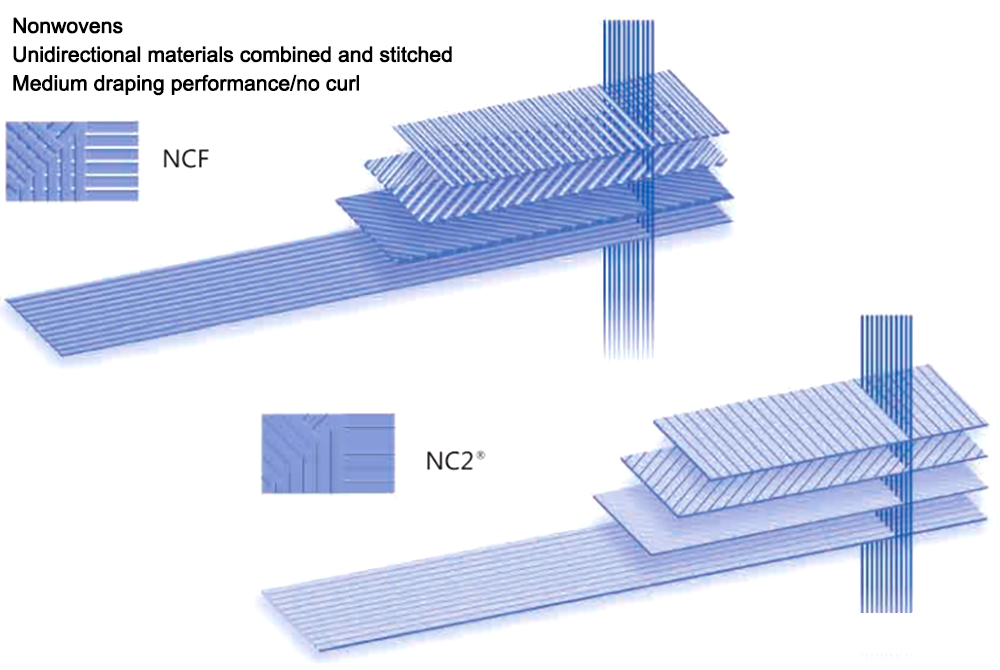
NCF |
Save time and cost-effectively.
Multi-directional strength and stiffness.
Unlimited laying direction.
Optimize fiber weight distribution in all directions
No curl.
Reduce waste caused by complex lay-up.
Reduce processing costs.
Can produce fabrics with large weight and area density.
|
Wind energy
(Blades)
|
| NC2® |
NCF upgraded version.
Seamless structure.
Suitable for large tow and high modulus fiber.
Even fiber distribution.
Improved mechanical properties (compression).
Improved resin flow effect.
|
Auto industry |


 Carbon fiber non-woven fabrics


